
Algorithm library
Multi-modality
Activity, cardio, sleep, respiratory, gait
Versioning
Tracked
Every release documented with change history
Validation
V3-aligned
Verification, analytical, clinical
Digital Endpoint Workflow
Signal → Algorithm → Endpoint → Evidence
In clinical research, a digital endpoint is a defined, validated measurement derived from wearable or connected-device data — used to answer a clinical question. It is not the raw sensor stream, and it is not the consumer-facing summary the patient sees on their phone.
A digital endpoint is reviewable. A consumer wearable feature is not.
Related pages: Signal Harmonization · Regulatory-Ready Endpoints
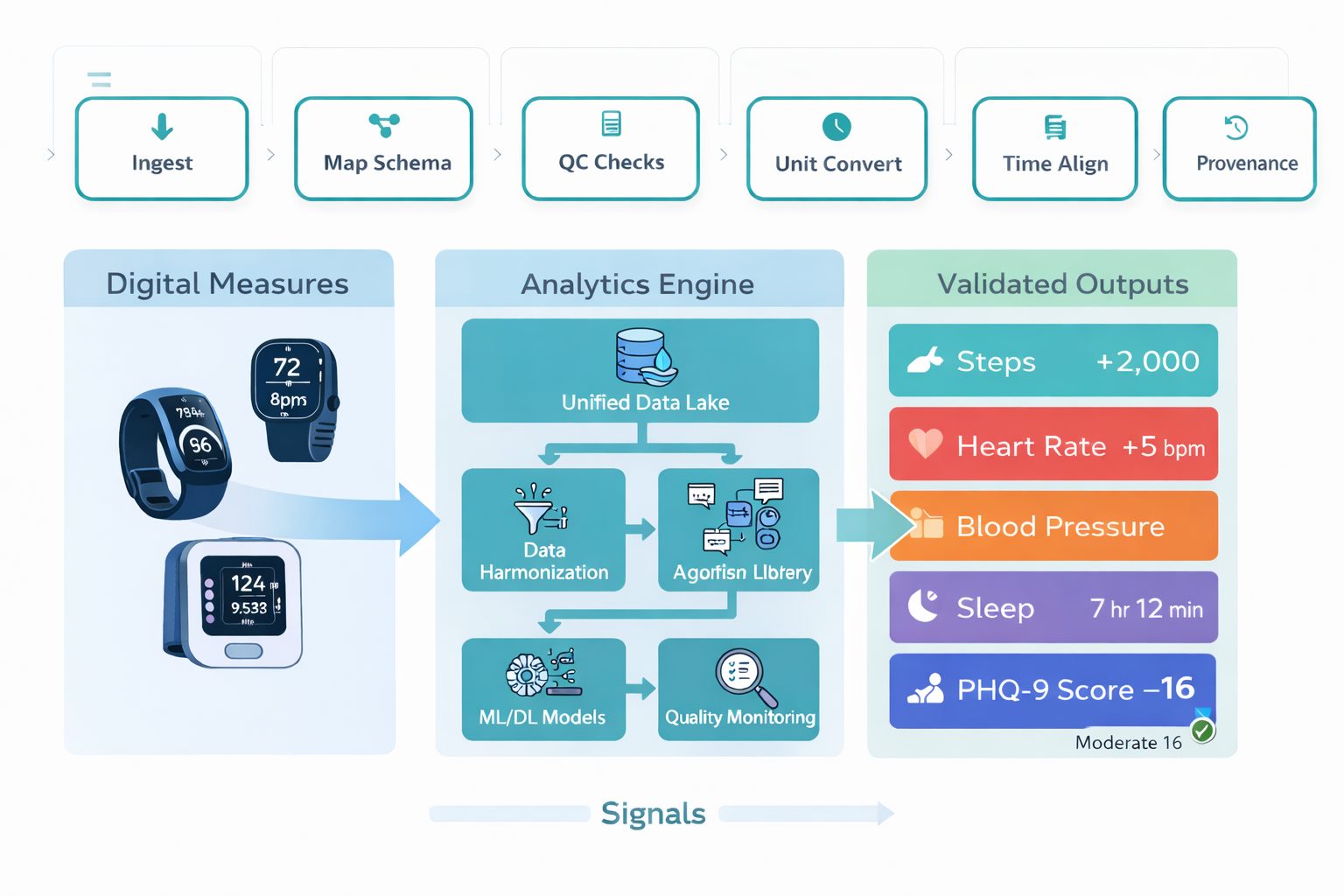
Most digital endpoint programs stall not because the sensor is wrong, but because the algorithm, validation, or provenance layer is missing.
Vendor 'step count' or 'sleep score' isn't a validated clinical endpoint, even if it looks like one.
When the math changes mid-study, results drift silently and re-analysis becomes impossible.
Without verification, analytical, and clinical validation, the endpoint can't survive review.
Values arrive without device, firmware, or algorithm context — leaving statisticians flying blind.
Algorithm produces a value, but the protocol defines the endpoint differently — forcing post-hoc work.
If you can't explain how the value was computed, you can't defend it in a submission.
An endpoint that can't be reproduced or defended is a metric, not a measurement.
An endpoint is only useful if it can be reproduced, reviewed, and defended.
Endpoints that survive a regulatory review are built around a documented method — not just a number that came out of a sensor.
Strong digital endpoints look the same on day one as they do at submission — that's the whole point.
See related pages: Validation · Endpoint APIs · Analytics
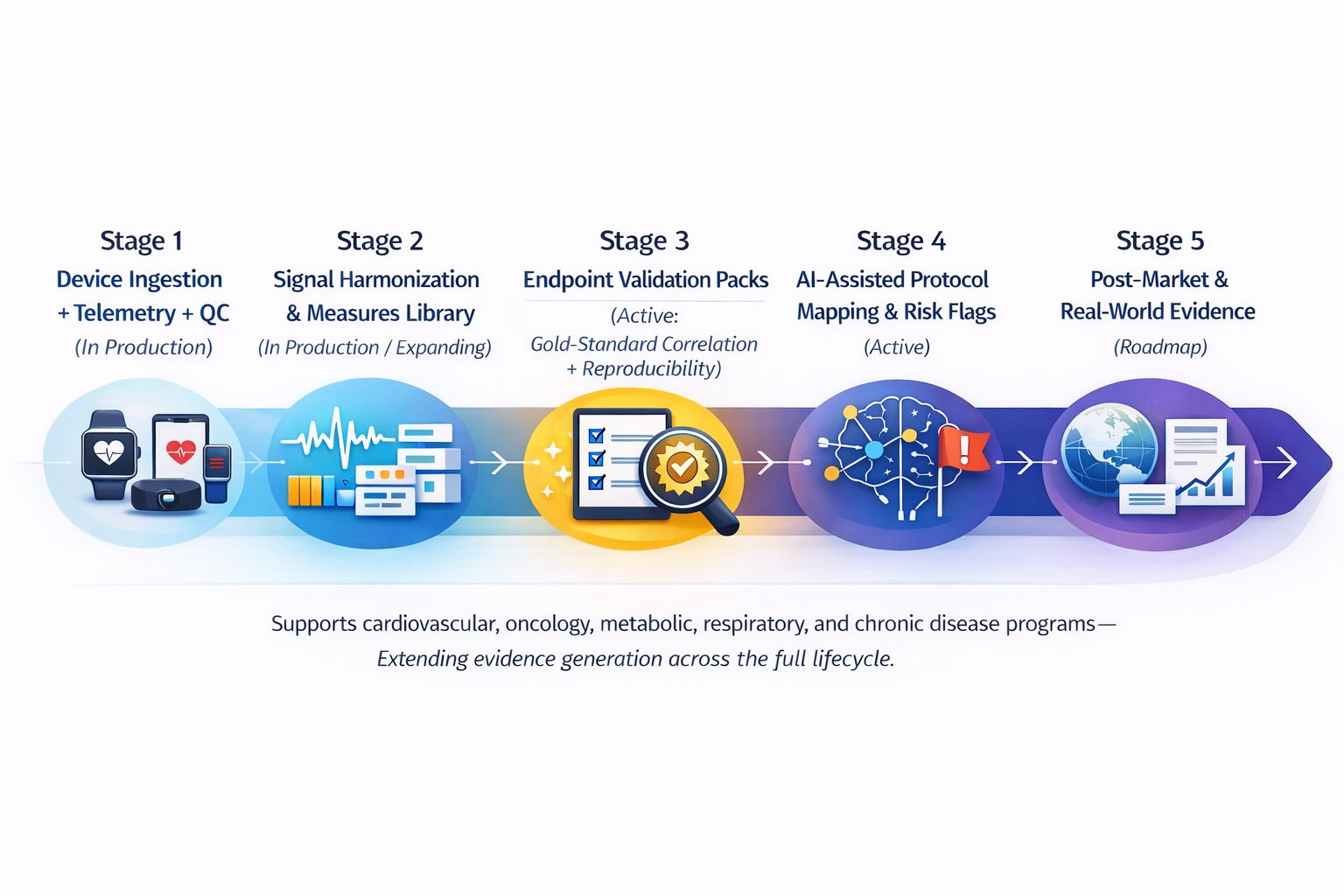
Delve's digital endpoint library covers the modalities most clinical programs need, built on the same harmonization and validation infrastructure.
Step quality, gait speed, daily activity volume, sedentary behavior.
HR, HRV, recovery metrics, BP trends, arrhythmia signal detection.
Sleep duration, efficiency, staging, sleep continuity over time.
Respiratory rate, SpO₂ trends, breathing-pattern stability.
CGM-derived adherence, time-in-range, weight trends.
Engagement with eDiary, training, and protocol-required tasks.
All endpoints flow through the same harmonization, QC, and API layers — so behavior across modalities is consistent.
Yes. Studies frequently define their own endpoint logic on top of the underlying validated algorithms. The protocol-specific layer is documented and versioned alongside the base algorithm.
Each endpoint goes through verification (sensor measures correctly), analytical validation (algorithm computes correctly on labeled data), and clinical validation (metric reflects the intended outcome). All three layers are documented.
Algorithms are versioned. New versions can be introduced for new cohorts while existing data stays on its original version — preserving reproducibility for analyses already in flight.
Delve builds digital endpoints as a fit-for-purpose, validated, versioned, documented layer on top of harmonized wearable and connected-device data.
Book a Digital Endpoint Discussion