
eCOA completion
92–98%
Across programs combining the platform with concierge follow-up
Retention uplift
Up to 63%
Reported in long-duration / rare-disease cohorts
Sites supported
Globally
Multi-region, multi-device studies
Outcomes Workflow
Run → Measure → Document → Compare
When we talk about outcomes on this page, we mean operational compliance and retention numbers reported by Delve customers across their studies. We publish ranges rather than averages, and we attribute outcomes to studies — not to the platform in the abstract.
All numbers are documented per study in case studies. Your study's results will reflect your study's protocol, population, and operating model.
Related pages: Case Studies · Concierge
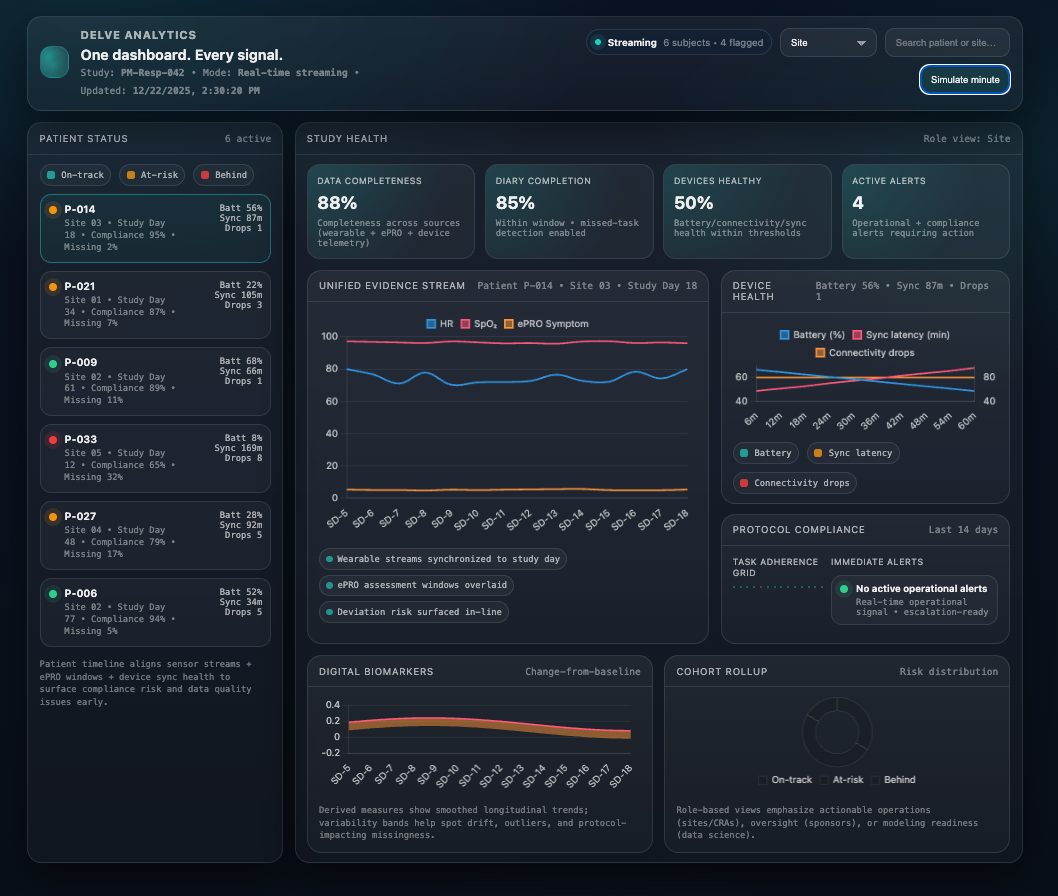
Most vendor outcome claims are misleading not because the numbers are fake, but because the context is missing. An industry-average compliance number doesn't tell you what to expect in your study.
Hide the variation that actually predicts your study's experience.
Top-decile results presented as typical — without disclosure that they aren't.
Numbers presented without saying which study, what population, or what protocol they came from.
Old numbers from old protocols repeated for years without re-measurement.
Compliance from a healthy-volunteer study compared to a chronic-disease trial.
Form completion ≠ wear-time ≠ retention ≠ adherence. Vendors use whichever flatters them.
Outcomes are useful only when the context that produced them is published alongside them.
We don't beat industry averages. We publish numbers customers can compare to their own context.
Useful outcomes reporting is structured the same way regulators expect endpoint reporting to be structured — with attribution, context, and reproducibility.
Numbers presented this way let a sponsor compare their context to ours — which is the only useful comparison.
See related pages: Case Studies · Closed-Loop Compliance · Concierge
Operational outcomes show up across the same layers Delve operates: data collection, compliance, retention, site experience, and downstream evidence.
High completion rates across programs that combine the platform with concierge follow-up.
Measurable reduction in non-wear and sync gaps in long-duration studies.
Improved drop-out in long-duration, rare-disease, and post-market cohorts.
Coordinator-reported reduction in compliance-related escalation.
Faster path from collection to analyzable dataset through harmonization + QC.
Validation and documentation built alongside the study, not retrofitted at filing.
Each of these is documented per study in case studies — including the protocol, population, and operating context.
Single numbers hide the variation that actually predicts a sponsor's own experience. Ranges with attribution let you compare your study's context to ours — which is the only useful comparison.
Largely yes. The highest compliance and retention outcomes come from programs that combine the platform with concierge follow-up. Platform-only deployments produce more modest results.
We publish per-study results in case studies. Underlying patient-level data is the property of each sponsor and isn't redistributed, but the study-level outcomes and protocol context are.
Delve publishes per-study outcomes, ranges, and operating-model context so sponsors can compare what we've produced to what their own studies require — without industry-average marketing.
Talk Through Our Outcomes