
Diary drift
Slow
Until it compounds
Root cause
Ops
Not just software
Recovery window
<72h
Earlier is better
eCOA Recovery Model
Detect → Act → Recover → Escalate
eCOA data fails when trials treat digital capture as a software problem instead of an execution problem. The forms may be configured correctly, but data continuity still breaks when patients drift, tasks are missed, support is weak, or study teams discover the problem too late to recover it well.
Missing data is often the downstream symptom. The real failure started earlier.
Related reading: What is eCOA in Clinical Trials?

Real-world eCOA failure is usually gradual and operational. These are the most common patterns that weaken completion and longitudinal data quality.
Patients often start strong, then completion softens as burden, fatigue, or routine disruptions accumulate.
If patients do not clearly understand what to do, when to do it, and why it matters, missed tasks become more likely almost immediately.
When teams review completion too late, small misses become multi-day gaps that are harder to explain or recover.
Without a dedicated operational layer, research sites end up troubleshooting technology and chasing routine tasks manually.
eCOA, wearables, reminders, logistics, and support often live in separate systems with no single owner of data continuity.
Even a valid instrument can underperform if the digital workflow feels confusing, repetitive, inaccessible, or burdensome.
Many teams can identify missing data after the fact, but do not have clear intervention rules for recovering it while there is still time.
None of these are theoretical. They happen in routine study execution, which is why monitoring alone is not enough.
Missing data is often discovered late, but the operational failure started much earlier.
In many studies, sites become the default recovery engine. They answer patient questions, chase missed entries, troubleshoot app confusion, coordinate device issues, and still try to run the protocol efficiently.
A better model reduces site burden by handling routine recovery and only escalating when the issue truly needs site involvement.
Related pages: Site Enablement · Concierge

The longer a missed task sits untreated, the harder it becomes to recover with confidence. This is why real-time visibility matters so much in eCOA.
Teams can still nudge, clarify, or troubleshoot while the patient context is fresh and the task is still recoverable.
Missed tasks begin to stack, patient memory weakens, and the operational effort required for clean recovery increases.
By the time gaps are found in review or reconciliation, teams are often explaining missingness instead of truly recovering it.
The practical lesson is simple: eCOA recovery is a timing discipline, not just a reporting feature.
The strongest eCOA programs are built around recovery, not just configuration. That means more than launching forms and dashboards.
In practice, success comes from pairing digital infrastructure with human follow-through.
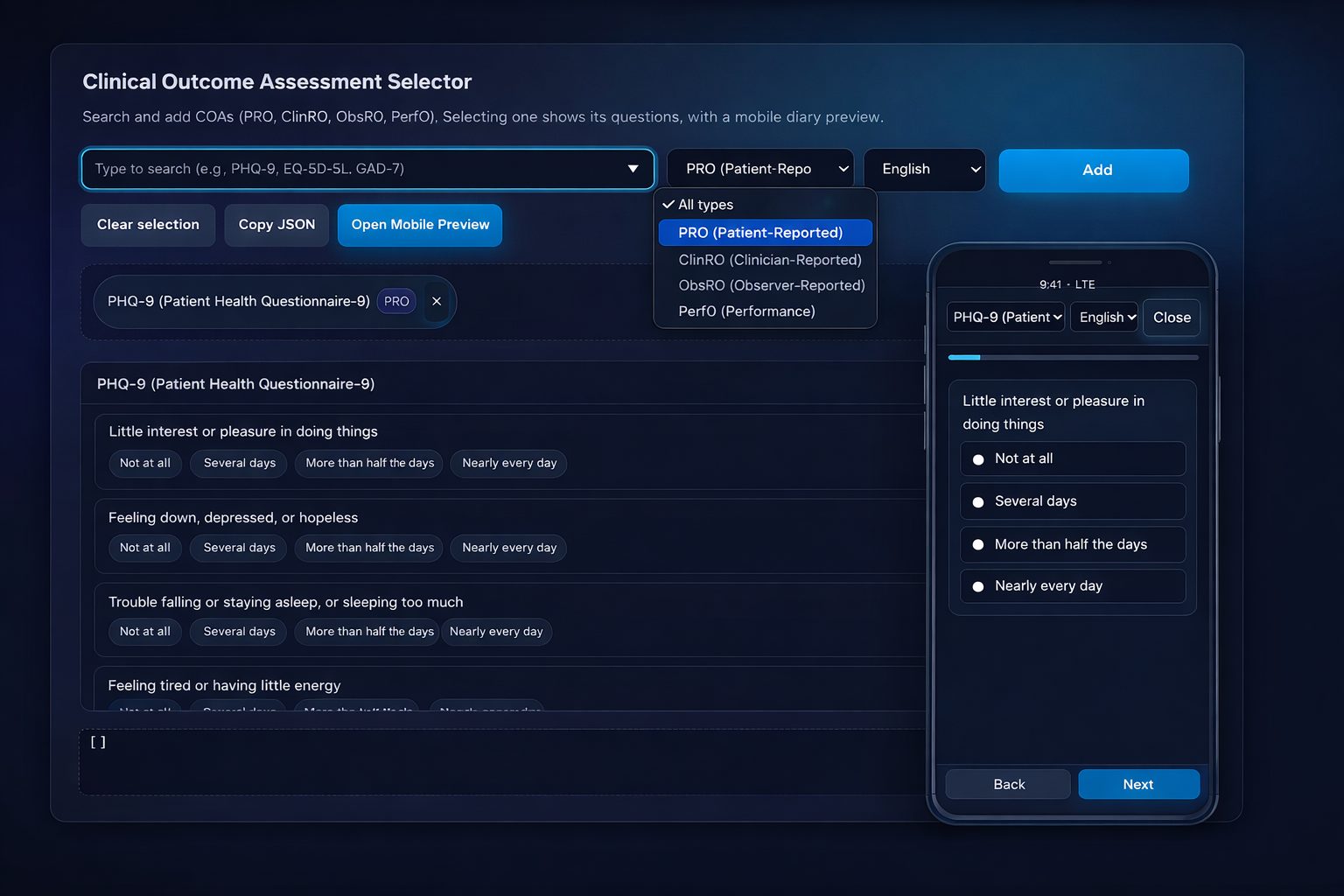
Delve’s view is that eCOA is not just a software category. It is an operational system that must keep data happening throughout the study—not just collect it when things go perfectly.
But software alone does not guarantee that people complete them consistently over time.
Outreach, support, and intervention are often what prevent short-term misses from becoming real data loss.
The best eCOA strategy is one that protects completion, site capacity, and longitudinal outcome continuity together.
Explore the related platform pages: eCOA · Analytics · Concierge-as-a-Service™
Not entirely. Patient behavior matters, but many failures come from poor onboarding, delayed intervention, fragmented support, and lack of operational recovery.
No. Dashboards help teams see problems, but they do not resolve them. Recovery requires follow-up, playbooks, and clear ownership.
Because data continuity is not protected by form design alone. Longitudinal quality depends on keeping patients engaged and issues recoverable over time.
Delve combines digital assessments, real-time oversight, human support, and site-aware recovery workflows to help sponsors protect completion, reduce burden, and preserve longitudinal outcome integrity.
Book an eCOA Strategy Walkthrough