
eCOA scope
4
PRO · ClinRO · ObsRO · PerfO
Visibility
Real-time
Completion + data quality
Modern trials
Hybrid
Remote + site-based workflows
Modern eCOA Workflow
Capture → Monitor → Recover → Protect
Electronic Clinical Outcome Assessment (eCOA) is the digital collection of clinical outcome data used to understand how a patient feels, functions, or survives during a clinical trial. It replaces paper-based assessments with structured digital workflows that can be completed remotely or on site.
eCOA is not just a digital form. In modern trials, it is part of the infrastructure used to protect data quality, support compliance, and reduce missing longitudinal outcome data.
Related reading: eCOA & ePRO platform

Trials increasingly rely on patient-generated and remotely collected outcome data. That makes digital outcome capture essential—not just for convenience, but for data quality, oversight, and speed.
Electronic capture reduces transcription errors, incomplete paper diaries, and delayed visibility into missing data.
Digital workflows provide timestamps and structured completion records that are more inspection-ready than paper processes.
Study teams can see who has completed tasks, who is drifting, and where intervention may be needed.
eCOA supports site-based, decentralized, and hybrid workflows without forcing all outcome data through paper and manual review.
Mobile and guided digital completion can be easier than paper packets, especially when reminders and support are built in.
When teams monitor completion in real time, they can recover missing data earlier instead of discovering gaps much later.
The biggest advantage of eCOA is not that it is electronic. It is that it can create earlier visibility—and earlier recovery—when studies are designed well.
In simple terms: all ePRO is part of eCOA, but not all eCOA is ePRO.
As clinical research moves beyond the site, eCOA becomes one of the most important tools for collecting structured outcome data outside traditional visit windows.
In hybrid studies, the challenge is not only digital capture. It is the coordination of reminders, timing, usability, completion checks, and follow-up when a patient falls behind.
Many teams assume eCOA success is mostly about selecting software. In practice, failure usually comes from weak execution around the software.
Patients forget, get fatigued, lose motivation, or struggle with the workflow over time.
Completion issues are discovered too late, when recovery is harder and the missingness has already compounded.
Coordinators become de facto help desks when there is no defined operational layer to handle routine problems.
eCOA, devices, alerts, logistics, and support live across vendors with no single owner of the full workflow.
Digital tasks can still fail if instructions are confusing, burdensome, or not accessible enough for the study population.
Even when forms are submitted, timing, quality, usability, and continuity still matter for trustworthy outcome data.
This is why Delve positions eCOA as an execution model, not just a software category.
A strong eCOA strategy includes more than questionnaires. It includes the operational pieces needed to keep those questionnaires complete and usable.
In short, eCOA works best when it is paired with operational follow-through.
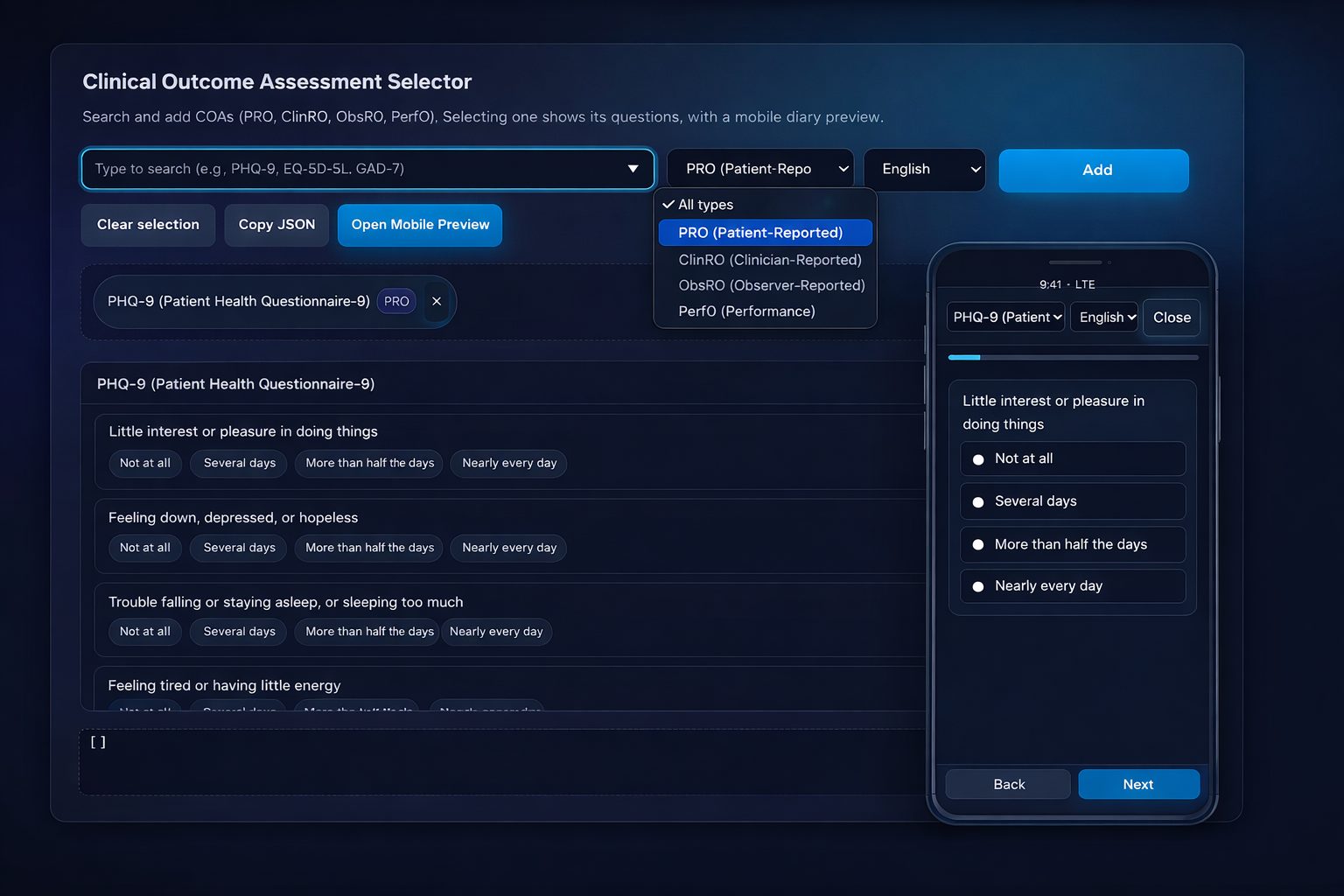
No. eCOA includes patient, clinician, observer, and performance-based outcomes collected electronically.
No. It is valuable in site-based, hybrid, and decentralized studies. The more complex the workflow, the more important execution becomes.
Yes. eCOA can be combined with connected devices and digital biomarkers to create richer context around how patients feel and function.
Delve combines eCOA, ePRO, wearables, analytics, and human support into one compliance-focused model designed to reduce missing data and protect longitudinal outcome integrity.
Book an eCOA Walkthrough