
Systems
2 → 1
Consent + outcomes, one platform
Visibility
Real-time
Consent status + data quality
Participant record
One
Consent through outcome, no reconciliation
Unified Consent-to-Outcome Workflow
Consent → Capture → Monitor → Recover
eConsent is the digital delivery of informed consent using multimedia education, comprehension checks, and electronic signature with a full audit trail. Electronic Clinical Outcome Assessment (eCOA) is the digital collection of clinical outcome data used to understand how a patient feels, functions, or survives during a clinical trial. Most sponsors procure these from two separate vendors.
Unifying eConsent and eCOA is not just a procurement decision. It changes how sites work day to day, how quickly consent issues surface, and how much manual reconciliation a study team carries for the life of the trial.
Related reading: eCOA & ePRO platform · eConsent platform

eConsent and eCOA are usually procured, implemented, and managed as two separate vendor relationships. That split creates operational cost that rarely shows up on a feature comparison chart.
Consent status, outcome data, and device signals live in one system instead of being stitched together across two platforms after the fact.
One data pipeline into EDC and analytics instead of two, which reduces mapping errors and vendor coordination overhead.
Coordinators and participants use one workflow and one support channel rather than switching between systems for consent and for outcome tasks.
Consent status can gate or inform eCOA workflows automatically instead of requiring a coordinator to manually confirm consent before enabling data collection.
Sponsors and monitors get one place to check consent status and outcome compliance instead of two separate reporting systems.
One contract, one support relationship, and one implementation timeline instead of coordinating two vendors through the life of the study.
The biggest advantage of unifying is not that it is fewer logins. It is that consent and outcome data stop needing manual reconciliation, which is where many studies quietly lose time and accuracy.
This is not just a vendor argument. Advarra's 2023 Study Activation Survey of more than 500 North American clinical research professionals found that 67% of sites say sponsor-provided technology has grown more burdensome over the past five years, and nearly 70% report needing six or more separate logins per study. A 2025 global Tufts CSDD survey of investigative sites, conducted with Evinova, found 22% report direct financial losses tied to technology coordination, troubleshooting, and training burden. IQVIA reached a similar conclusion in its own March 2026 analysis of eConsent and eCOA integration: independently mature platforms can create more operational burden than value when they are not connected.
Sources: Advarra, 2023 Study Activation Survey · Tufts CSDD / Evinova, 2025 site technology survey · IQVIA, "When eConsent and eCOA Work Together," March 2026
In simple terms: unifying does not just save logins. It removes the manual reconciliation work that separate systems create by design.
A unified platform extends the same real-time oversight sponsors expect for outcome compliance to consent itself, instead of leaving consent tracking in a separate system with its own dashboard.
In a unified platform, the challenge is not only digital consent capture. It is making sure consent status is visible in the same place as outcome compliance, so nothing falls into a gap between two systems.
See related pages: eConsent · Wearables · Analytics · Concierge

eConsent and eCOA are not governed by a single rulebook, and unifying them on one platform does not change which regulations apply. It changes how consistently a sponsor can demonstrate compliance with all of them from one system instead of two.
Governs the electronic records and electronic signatures used in both eConsent capture and eCOA data collection, including audit trail, access control, and record-integrity requirements.
Set the requirements for informed consent content and IRB review in FDA-regulated research and HHS-supported human subjects research, regardless of whether consent is captured on paper or electronically.
The joint FDA and HHS Office for Human Research Protections guidance on using electronic systems, including multimedia and remote formats, to obtain and document informed consent.
The FDA adopted E6(R3) as final guidance in September 2025, replacing the 2016 E6(R2). It emphasizes quality by design, risk-based quality management, and proportionate oversight across the trial lifecycle, including technology-enabled and decentralized elements.
None of these frameworks require a sponsor to run eConsent and eCOA on one platform. But ICH E6(R3)'s emphasis on risk-based, proportionate data governance across the trial lifecycle raises the practical bar for how consistently consent and outcome data need to be tracked, audited, and reconciled, whether that happens within one system or across two.
Sources: FDA, E6(R3) Good Clinical Practice (GCP), September 2025 · HHS OHRP / FDA, Use of Electronic Informed Consent, 2016
Many teams treat eConsent and eCOA vendor selection as two independent decisions. In practice, the seam between the two systems is where a lot of operational risk accumulates.
Coordinators must manually confirm consent status in one system before enabling outcome workflows in another.
Expired or incomplete consent can go unnoticed longer when it lives in a separate dashboard from outcome compliance.
Coordinators learn and support two separate systems instead of one consistent workflow.
Consent, outcomes, devices, and support live across vendors with no single owner of the full participant record.
Contract renewals, support escalations, and implementation timelines double instead of consolidating.
Participants switch between systems for consent and for outcome tasks, which adds friction at exactly the points where drop-off risk is highest.
This is why Delve positions unification as an execution decision, not just a procurement convenience.
A strong unified eConsent and eCOA strategy includes more than putting both workflows behind the same login. It includes the operational pieces that make one participant record actually work.
In short, unifying works best when it changes the operational model, not just the vendor invoice.
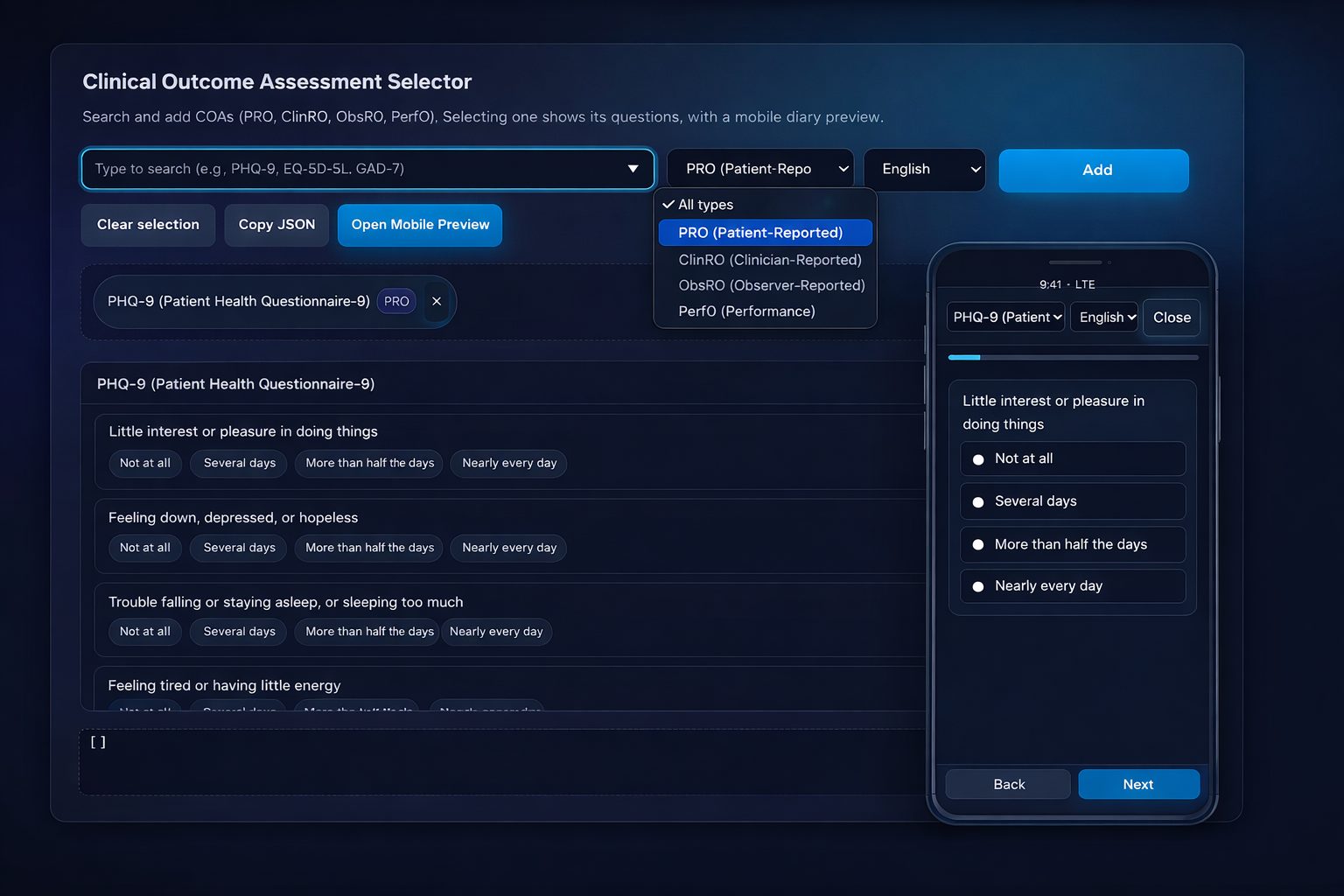
A participant's consent status, outcome data, and wearable signals live in one connected system rather than two separate vendor platforms.
Separate systems create duplicate integrations, duplicate training, and manual reconciliation between consent status and outcome eligibility. Unifying removes that overhead.
Yes. One data pipeline into EDC and analytics instead of two reduces mapping errors and vendor coordination.
Yes. Wearable and connected-device data can be harmonized alongside consent and outcome data in the same participant record.
21 CFR Parts 11, 50, and 56, 45 CFR 46 for HHS-supported research, the 2016 FDA/OHRP eConsent guidance, and ICH E6(R3) Good Clinical Practice, adopted as final FDA guidance in September 2025.
No. It does not mandate a vendor architecture, but its risk-based governance emphasis raises the bar for how consistently data is tracked. Unifying is now an industry-wide trend, not one vendor's claim — IQVIA has published a similar analysis, and what varies most between vendors is how much human follow-up backs the software.
Delve combines eConsent, eCOA, ePRO, wearables, analytics, and human support into one platform designed to remove the reconciliation work that separate vendor systems create.
Book a WalkthroughExplore the Delve eCOA platform → · Explore the Delve eConsent platform →