
Detection
Real-time
Continuous against incoming streams
Routing
Automated
To concierge, coordinator, or device-logistics
Resolution
Tracked
Every issue closed with documented evidence
Compliance Workflow
Detect → Triage → Resolve → Document
In clinical trials, automated compliance is the operational layer that watches incoming wearable and ePRO data for trouble — hardware faults, low battery, connectivity drops, missed entries, physiological anomalies — and routes each issue to the resolver who can actually close it.
Automated compliance is the difference between knowing a problem exists and actually closing it.
Related pages: Closed-Loop Compliance Engine · Signal QC
Most trials still review compliance manually, at weekly or monthly cadences. By then the recovery window has closed and the dataset is already different.
Issues surface at review meetings, days or weeks after they happened.
Sites are asked to chase compliance — but they don't have the time or visibility.
Alerts pile up without clear ownership; whoever sees the inbox first chases the loudest item.
Issues that need device-side action and patient-side support get split across systems with no link between them.
Escalation depends on a coordinator noticing — not on a rule that fires automatically.
Without resolution tracking, the same issue can recur silently across the cohort.
Compliance is only useful when it closes the loop between detection and resolution.
Automated compliance is what makes wearable + ePRO data trustworthy across the life of the study.
Compliance layers that hold up under long-duration, multi-region trials are built around routing and closure — not just alerting.
Strong automated compliance closes the gap between noticing something is wrong and actually fixing it.
See related pages: Closed-Loop Engine · Concierge · Signal QC
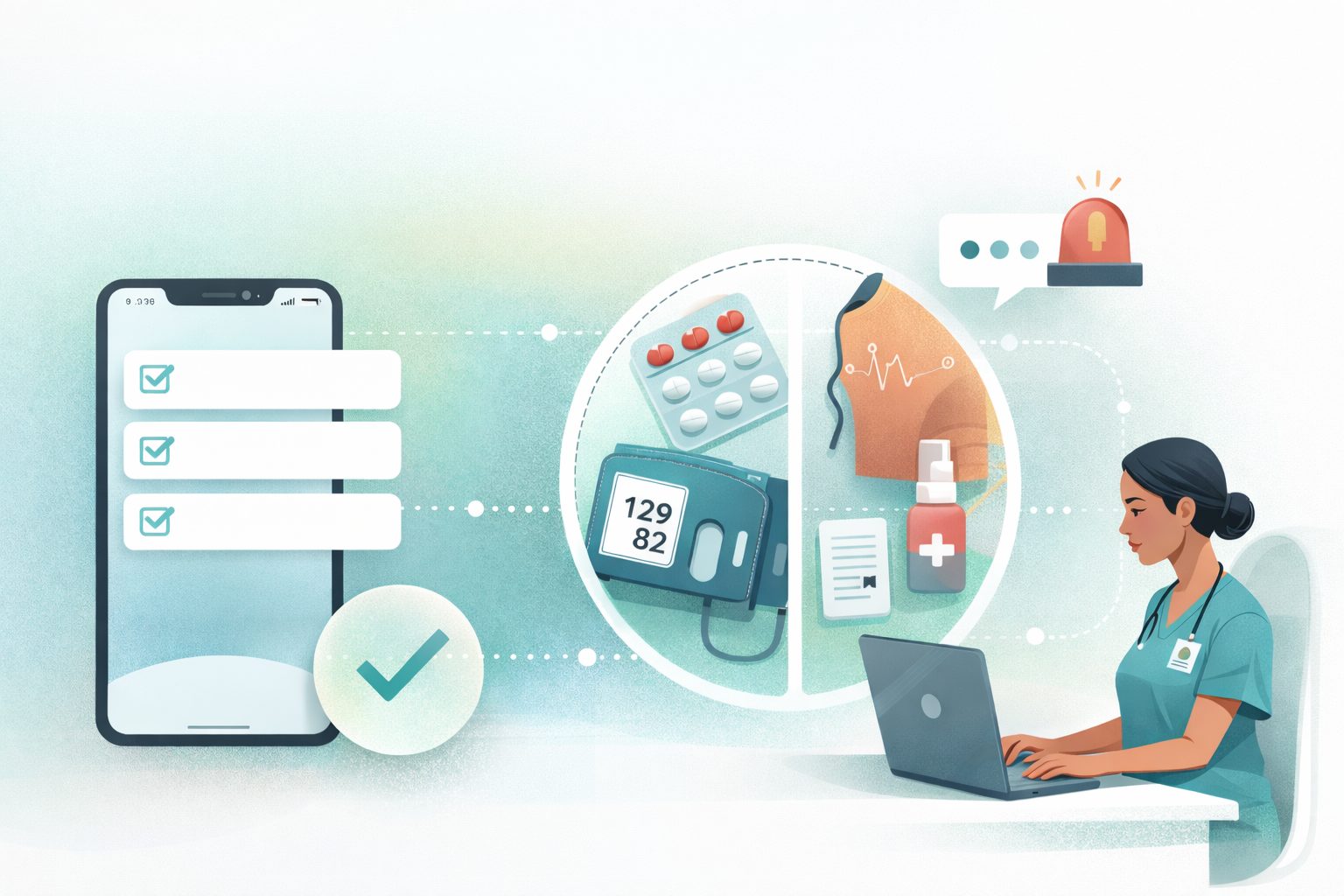
Detection runs against incoming streams continuously. Most signal-level issues surface within minutes; cohort-level rollups refresh on study-configured cadences.
Device faults, firmware mismatches, sensor disconnects.
Low-battery patterns, charging anomalies, missed charges.
Sync drift, app crashes, Bluetooth pairing failures.
Diary or questionnaire windows missed beyond protocol tolerance.
Out-of-range or implausible values likely indicating sensor placement issues.
Non-wear stretches breaching the protocol's compliance thresholds.
Every detection turns into a routed action — not just an alert in a queue.
Most signal-level issues are detected within minutes of occurring; rolled-up adherence reports refresh on study-configured cadences. Specific latencies depend on the upstream device and app.
Yes. Rules are tied to the protocol's own definitions of compliance and adherence — generic 'wear-time > X' thresholds aren't enough for endpoint-driven studies.
Into the Compliance Engine workflow: in-app message to the patient, multilingual concierge outreach, coordinator task, or device-logistics task — whichever the rule and context dictate.
Delve combines continuous detection, rule-based routing, and closed-loop resolution into one compliance layer designed to protect wearable and ePRO data continuity across the life of the study.
Book a Compliance Walkthrough