
Where studies actually fail
AI agents automate the easy part. Delve owns the hard part.
Medable's 2026 catalog of AI agents — CRA Agent, TMF Agent, PI Summary Agent — automates internal trial work: monitoring narratives, document classification, investigator summaries. These are real productivity wins. But none of them solve where clinical trials actually fail: patients drift, wearables go silent, compliance erodes, and endpoints degrade. That work is still fundamentally about validated engineering and human follow-through. It's where Delve specializes.
- TMF document classification & routing
- Monitoring narrative drafting
- PI summary generation from eCOA data
- Pattern detection in structured trial data
- Protocol-template study build acceleration
All internal-facing workflows. Real value.
- A patient who hasn't worn their device for 3 days
- A wearable producing physiologically implausible data
- An eCOA diary missed in a language the patient speaks at home
- A caregiver overwhelmed in a rare-disease trial
- Endpoint integrity when devices have firmware drift
Patient-facing, cross-cultural, real-world. Where studies break.
- 70+ validated wearable algorithms
- 7-dimension real-time compliance scoring
- Concierge-as-a-Service in 120+ languages
- 92–98% per-study eCOA/ePRO completion
- Up to 63% retention uplift in long-duration cohorts
- UI-driven multi-tenant rollout (US/NA, EU, LATAM, APAC, MENA) — no IT tickets, no per-region procurement
- Open endpoint APIs — REST + webhooks + CDISC + Parquet delivery into your EDC and analytics stack, with versioned contracts and provenance
Platform-owned outcomes. Documented per study.
Bottom line: If your bottleneck is internal trial documentation and monitoring administration, Medable's AI catalog is compelling. If your bottleneck is keeping patients engaged, devices working, and endpoints intact — which is where studies actually lose money — Delve is the better-fitting platform.
How Delve actually delivers 92–98% completion
Three engagement layers, not one
Other platforms bet on a single approach: configurable software (YPrime), AI agents (Medable), rater services (Signant), or core-lab pedigree (Clario). Delve combines three engagement layers on top of one validated wearable platform — which is why per-study completion lands at 92–98% vs. the published industry baseline of 80–90%.
Fully featured eCOA you can build any study on. Configurable without engineering tickets.
- Branching logic, edit checks, scheduling, scoring, version control
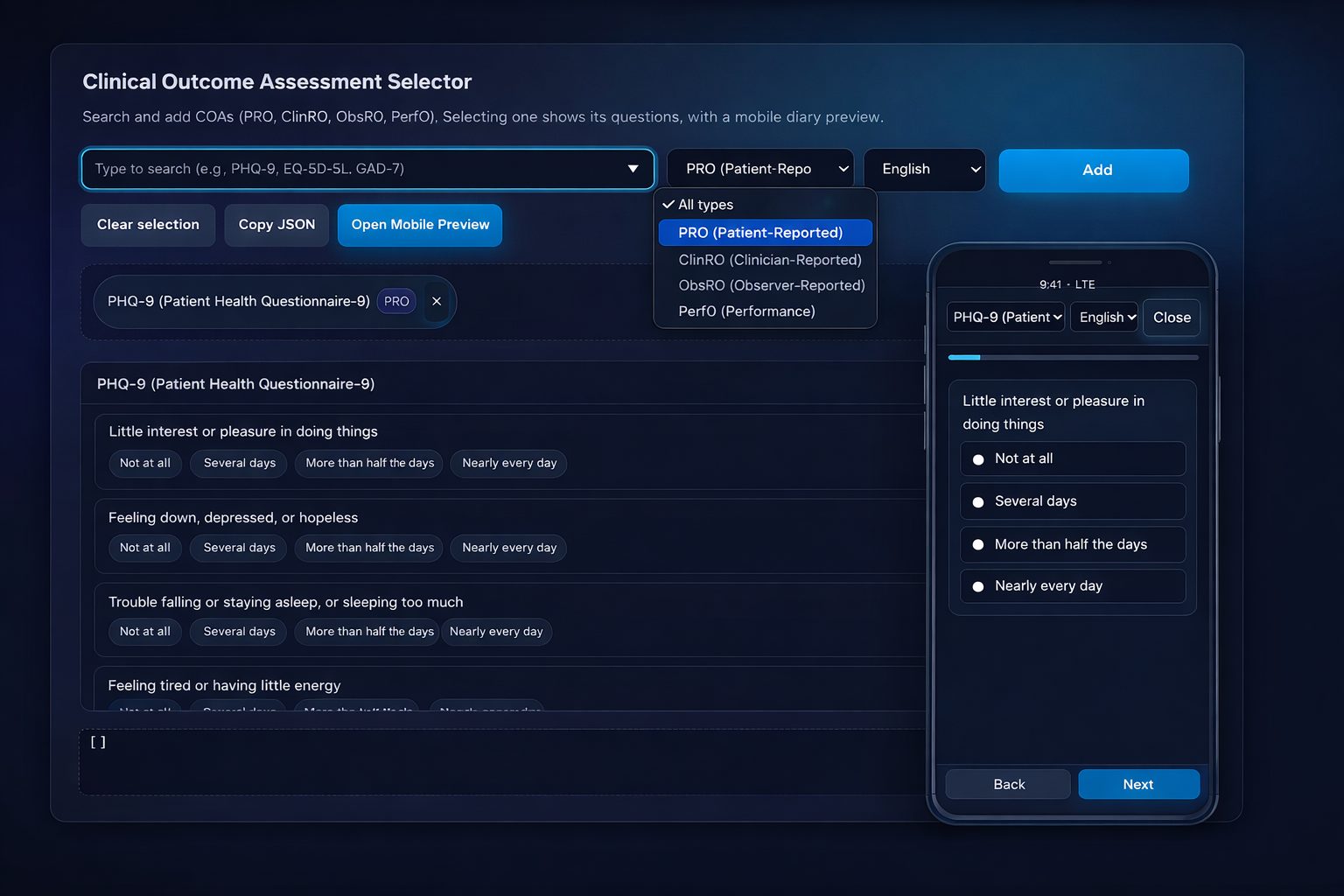
- Validated PRO / ClinRO / ObsRO / PerfO instrument support
- Pre-built diary templates + form builder for custom protocols
- 120+ language delivery, BYOD or provisioned devices
- UI-driven multi-tenant rollout (US/NA, EU, LATAM, APAC, MENA)
Engagement before patients drift. Built into the platform — not a separate product to license.
- Smart push notifications & configurable reminders
- Adaptive UX that responds to completion patterns
- Multimedia guidance (video, audio, visual prompts)
- Patient app with centralized "For You" task view
- Multilingual prompts in the patient's preferred language
When tech engagement isn't enough — humans recover the patient before data goes missing.
- 120+ languages of trained human concierge
- Documented <24h response windows
- Watch-level alerts triaged before they reach sites
- Caregiver support for rare-disease & pediatric trials
- Device troubleshooting, re-engagement, escalation
Why this combination works: Configurable software alone produces blank forms patients ignore. Engagement alerts alone produce notification fatigue. Human concierge alone is expensive and doesn't scale. The three together, operating on one validated wearable platform, are what produce 92–98% completion in real studies. Every other vendor in this comparison provides one or two of these layers — not three.
Two different bets
AI agents or validated engineering + human concierge?
Both platforms cover the same core surface — eCOA, ePRO, eConsent, wearables, analytics — but they bet on different operating models. Medable is going hard on agentic AI. Delve is doubling down on validated wearable engineering plus human concierge. The right answer depends on the protocol.
Two distinct 2026 strategies
- Medable's bet: Agent Studio + pre-built AI agents (CRA Agent, TMF Agent, PI Summary Agent) automating trial monitoring, document processing, and site oversight.
- Medable also offers: generative-AI eCOA build (reportedly cutting outcome-assessment build from days to 30 minutes), and one-day study startup ambitions on top of the standard DCT stack.
- Delve's bet: 70+ validated wearable algorithms on a harmonized clinical data layer, plus Concierge-as-a-Service in 120+ languages.
- Delve's commitment: 92–98% per-study completion ranges and up to 63% retention uplift, documented per study.
- Match the automation model to where your compliance loss actually happens.
Delve-documented eCOA/ePRO completion range, per study.
Up to 63% retention uplift in long-duration cohorts (Delve).
Validated digital-endpoint algorithms across 25+ wearables.
Languages of human concierge, built into the platform.
Where the two platforms genuinely overlap
At the feature checklist level, Medable and Delve Health support most of the same core capabilities. Either platform can run a modern decentralized or hybrid trial successfully. Both platforms ship:
- Digital informed consent (eConsent) with multimedia and audit trail
- Electronic Clinical Outcome Assessment (eCOA) and patient-reported outcomes (ePRO)
- Wearable and digital health technology integration
- Real-time analytics dashboards for study oversight
- Decentralized and hybrid trial design support
- Full compliance posture: HIPAA, GDPR, 21 CFR Part 11, ICH GCP, ISO 27001
The differences show up only once you ask what happens when compliance starts to drift, when a wearable produces unusable data, or when sites need relief.
Side-by-side comparison
Medable vs Delve Health: capability comparison
The table below reflects publicly documented capabilities and standard delivery models for each platform. Specific configurations may vary by contract.
| Capability | Medable | Delve Health |
|---|---|---|
| Outcomes — where studies live or die | ||
| Per-study completion rate accountability | Customer-driven | 92–98% documented per study |
| Retention uplift target | Customer-driven | Up to 63% in long-duration cohorts |
| Validated digital-endpoint algorithms | Vendor-supplied metrics | 70+ algorithms across ECG, glucose, activity, sleep, frequency & QC |
| Real-time compliance scoring | Dashboard alerts after the fact | 7-dimension hourly readiness + closed-loop recovery |
| Human concierge patient support | Professional services / partner add-on | Built into platform — 120+ languages, <24h response windows |
| Wearable device support | Selected devices, vendor-supplied data | 25+ devices on harmonized clinical data layer |
| Site burden reduction | Dashboards + AI summaries for PIs | Concierge triages alerts before sites see them |
| Architecture & speed to launch globally | ||
| Multi-region tenant rollout | Enterprise contract per region; AI-agent automation focuses on internal workflows | UI-driven multi-tenant — spin up region-aware tenants (US/NA, EU, LATAM, APAC, MENA) without IT tickets or per-region procurement |
| Diary & eCOA template library | Generative-AI eCOA build (claimed 30-min outcome assessment build) | Pre-built diary templates for rapid eCOA build, plus configurable form builder for custom protocols |
| Self-serve admin platform | Vendor-administered; AI agents for trial workflows | Admin UI for tenant management, user roles, audit log, diary template library |
| API & EDC / analytics integration | Modern SDK + APIs; integration focus is AI agent extensibility | Endpoint APIs with lineage — REST pull + webhook push + batch + CDISC packages + Parquet, with versioned contracts, provenance, audit trail and direct EDC delivery |
| Built-in audit log accessible to sponsors | Available on request from vendor | Live admin UI — sponsors and CROs can self-audit |
| Internal automation — where Medable focuses | ||
| Agentic AI platform | Yes — Agent Studio (no-code agent builder) | AI-assisted QC, not agent-first |
| Pre-built AI agents | CRA, TMF, PI Summary agents | Focus on validated engineering + human ops |
| Generative AI for study build | Yes — 30-min outcome assessment build | Template-based eCOA configuration |
| Telehealth & video visits | Yes — core capability | Yes — built into platform |
| Shared baseline | ||
| eCOA / ePRO platform | Yes | Fully configurable eCOA — adaptive UX, branching logic, multimedia, 120+ languages, validated PRO/ClinRO/ObsRO/PerfO instruments, version control without engineering tickets |
| Patient engagement model | AI-led engagement automation; multilingual concierge via professional services | Multi-layered — smart reminders + adaptive UX + multimedia guidance + multilingual prompts + human concierge in 120+ languages when tech isn't enough |
| eConsent | Yes | Yes — multimedia with audit trail |
| Compliance posture (HIPAA, GDPR, 21 CFR Part 11, ICH GCP, ISO 27001) | Yes | Yes |
| Engagement model | ||
| Pricing model | Platform license + professional services + AI agent add-ons | Outcomes-scoped integrated engagement |
| Accountability for outcomes | Customer's clinical operations team | Delve owns drift recovery between visits |
| Strongest fit | Enterprise pharma DCT programs prioritizing internal-workflow AI | Wearable-heavy, long-duration, or compliance-critical studies where completion is the deliverable |
Why outcomes-grade studies pick Delve
Four reasons sponsors choose Delve when patient compliance, wearable endpoint integrity, or retention are the deliverable — not the customer's problem to solve.
Completion guaranteed, not hoped for
Delve publishes documented 92–98% per-study eCOA/ePRO completion ranges as a platform deliverable. Medable provides tools; the customer's clinical operations team owns the completion number. Different accountability models.
Your algorithm, not the device's
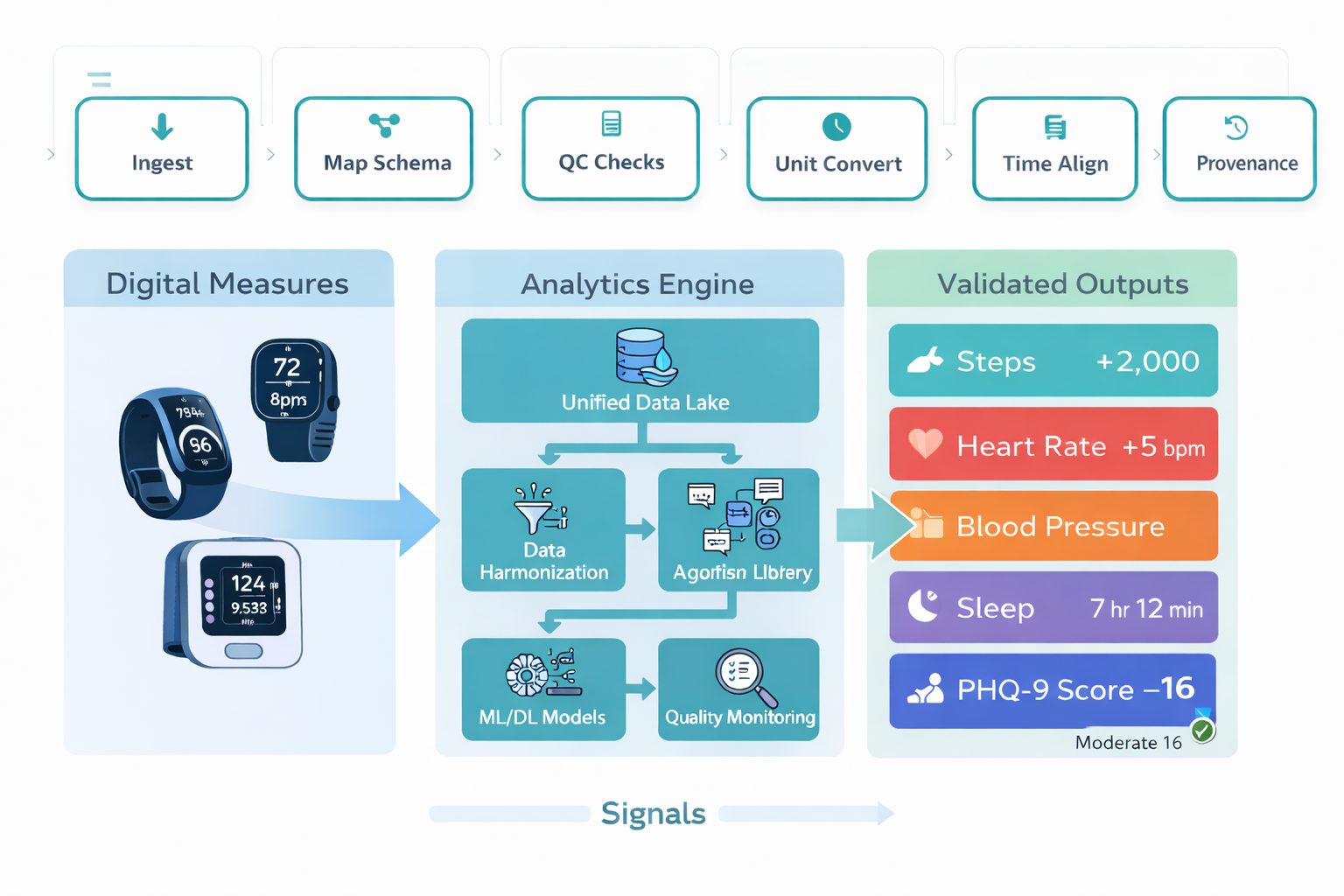
70+ validated digital-endpoint algorithms across ECG, glucose, activity, sleep, frequency, and QC — running on Delve's harmonized data layer, not consumer-grade vendor SDKs. Endpoint integrity is engineered, not assumed.
Humans recover patients. Period.
Patient drift gets recovered by trained humans in 120+ languages, not chatbots. AI agents handle internal paperwork well; they don't solve a caregiver in a rare-disease trial who's burned out, or a non-native speaker confused by an ePRO prompt.
Hourly readiness, not weekly reports
7-dimension compliance scoring updated every hour (coverage, wear, sync, battery, disconnects, latency, firmware). Watch-level alerts route to Delve concierge before sites see them. Medable's AI summaries are a downstream view of monitoring data.

1. Human concierge vs. AI agents
Medable's 2026 strategy automates trial workflows through agentic AI. Agent Studio, CRA Agent, TMF Agent, and PI Summary Agent reduce burden by automating monitoring narratives, document processing, and investigator oversight. Patient-facing support runs through Medable's patient apps, video visits, and (where needed) professional services.
Delve includes Concierge-as-a-Service as a built-in platform layer, with humans operating in 120+ languages, with documented response windows and escalation rules. The model targets the compliance loss that happens between visits — missed diaries, device confusion, wear-time decay — through trained humans, not chatbots.
Why it matters: AI agents are increasingly good at automating workflows with structured inputs (documents, narratives, summaries). They are still less effective at the messy, cross-cultural, multilingual patient outreach that drives compliance recovery. Match the automation model to where your compliance loss actually happens.
2. Wearable platform depth
Medable integrates with selected wearables and relies more heavily on vendor-supplied metrics. Delve runs 70+ validated digital-endpoint algorithms across 25+ supported devices on a harmonized clinical data layer that normalizes units, sampling rates, time bases, QC flags, and algorithm versions.
The data-layer engineering is the part most evaluators miss. Two vendors can both “support wearables” and have very different validation evidence behind the data each platform produces.
Why it matters: for wearable-heavy studies, endpoint integrity depends on more than just data ingestion. Validation evidence is part of the submission package.
Which platform fits your study
Choose the platform that fits your operating model
Both platforms run modern clinical trials successfully. The right answer depends on your study profile and your internal operating model.
Choose Medable if…
- You want to bet on agentic AI for trial workflow automation (Agent Studio, CRA Agent, TMF Agent, PI Summary Agent)
- You need a broad DCT enablement suite spanning telehealth, eConsent, eCOA, and study build automation
- Your enterprise has standardized on a single DCT platform across many trials
- You have strong internal clinical operations capacity to drive compliance recovery
- You want to automate TMF processing, monitoring narratives, and investigator oversight
- You prefer to assemble patient support services separately from platform software
Choose Delve Health if…
- You're launching a multi-region study and need self-serve UI-driven tenant rollout (US/NA, EU, LATAM, APAC, MENA) with pre-built validated diary templates available on day one
- You want platform-owned completion and retention as a deliverable, not a customer responsibility
- Your study is wearable-heavy and endpoint integrity depends on 70+ validated digital biomarkers
- You need multilingual human patient support in 120+ languages built into the platform — not professional services
- Your protocol is long-duration, complex, or high patient burden — rare disease, oncology, CNS, post-market
- You want documented per-study completion benchmarks (92–98%) and retention uplift (up to 63%) in your scope
- Your compliance loss happens through patient drift between visits, not paperwork backlog
Frequently asked questions
Questions sponsors ask when comparing Medable and Delve Health
These answers clarify the operational differences and how to evaluate them for your protocol.
How is Delve Health different from Medable in 2026?
Medable's 2025-2026 strategy centers on agentic AI: Agent Studio (described as the industry's first agentic AI platform for clinical development), plus pre-built agents including CRA Agent for trial monitoring, TMF Agent for trial master file automation, and PI Summary Agent for principal investigator oversight of eCOA data. Delve Health's strategy centers on validated wearable engineering (70+ digital-endpoint algorithms across 25+ devices on a harmonized data layer) plus human Concierge-as-a-Service in 120+ languages, with completion and retention as platform-owned outcomes. The two platforms cover the same core surface (eCOA, ePRO, eConsent, wearables, analytics) but bet on different operating models — AI automation vs validated engineering plus human follow-through.
What is Medable Agent Studio and how does it compare to Delve's approach?
Medable Agent Studio is a no-code agent builder for clinical teams to configure AI agents that automate trial workflows. Medable has published several pre-built agents on top of it. Delve does not currently offer an agentic AI platform of equivalent scope. Delve's automation focus is on real-time signal QC and compliance-recovery workflows operated by human concierge in 120+ languages. Sponsors who want to automate document processing, monitoring narratives, or site oversight via AI may find Medable's agent catalog compelling; sponsors who want platform-owned compliance and retention outcomes with human follow-through may find Delve's model better fit.
Is Delve Health a Medable competitor?
Yes, but with different focus. Medable positions broadly as a Decentralized Clinical Trial enablement platform. Delve Health positions as a clinical trial compliance and retention operating system. The product surface overlaps significantly on eCOA, ePRO, wearable integration, eConsent, and analytics. Sponsors typically choose between them based on whether their priority is broad DCT tooling or operational compliance and retention outcomes.
What completion rates does Delve Health document versus Medable?
Delve Health publishes per-study eCOA/ePRO completion rates in the 92–98 percent range, with retention uplift up to 63 percent in long-duration cohorts. These outcomes are presented as platform-owned metrics tied to the integrated concierge model. Medable publishes patient-engagement and DCT enablement metrics broadly across its customer base but does not commit to comparable per-study completion ranges in public materials.
Does Medable include patient support like Delve's concierge?
Medable provides patient experience tooling, video visit support, and patient apps. Human patient support, multilingual outreach, proactive compliance follow-up, and real-time recovery operations are typically delivered through Medable's professional services or a partner. Delve includes this as Concierge-as-a-Service built into the platform, operating in 120+ languages, and is responsible for compliance recovery as a platform outcome.
Which platform is better for wearable studies?
For wearable-heavy studies, the differentiator is the depth of the validated algorithm library and the data-layer engineering behind it. Delve runs 70+ validated digital-endpoint algorithms across 25+ wearable devices on a harmonized clinical data layer that normalizes units, sampling rates, time bases, QC flags, and algorithm versions. Medable integrates with wearables but relies more heavily on vendor-supplied metrics. Sponsors with endpoint-grade wearable requirements typically need to evaluate the validation evidence behind each platform's wearable pipeline.
How do pricing models compare between Medable and Delve Health?
Medable typically prices as a platform license plus professional services for patient support, integration, and customization, common for enterprise DCT platforms. Delve Health prices as an integrated operating model where eCOA, wearables, analytics, and concierge support are scoped together against the trial's compliance and retention outcomes rather than a la carte. The right model depends on whether the sponsor wants vendor-led execution accountability or to assemble services internally.
When should I choose Medable over Delve Health?
Choose Medable when the priority is AI-led automation of internal trial workflows (Agent Studio, CRA Agent, TMF Agent, PI Summary Agent), you have strong internal clinical operations capacity to manage compliance recovery, and your platform decision is being made at the enterprise level across many trials. Choose Delve Health when the priority is documented per-study compliance and retention outcomes, multilingual human patient support, depth of validated wearable endpoints, and an operating model where the platform partner owns drift recovery between visits.
Related learning
Build a complete picture before you commit
Knowledge pages that help sponsors evaluating eCOA, DCT, and wearable platforms understand what separates execution-grade vendors from platforms that look good in demos.
How to choose an eCOA vendor
Evaluation criteria beyond software — execution, support, compliance, site impact.
Read the guide →eCOA Vendor Comparison framework
Dimensions that predict study performance — used to compare any pair of platforms.
Open the framework →Why eCOA data fails in real-world trials
Missed diaries, patient drift, fragmented systems — hidden failure modes and what fixes them.
Read more →How to measure compliance in clinical trials
A practical, vendor-neutral framework for measuring compliance across modalities.
Read more →Evaluating Delve against your current stack?
If you are comparing Medable, Delve, or other DCT/eCOA platforms, ask each vendor one question: what happens when a participant stops responding? The answer tells you more than any demo.
Book a Platform Walkthrough