
ePRO completion with support
92–98%
What human-backed eCOA workflows achieve
Key differentiator
Execution
Technology plus human support, not technology alone
Vendor fragmentation risk
High
When eCOA, wearables, and concierge are separate vendors
eCOA Vendor Evaluation
Technology → support → compliance → data quality
What to Actually Evaluate When Comparing eCOA Vendors
Most eCOA vendor comparisons focus on interface quality, configurability, and regulatory validation. These matter, but they do not predict completion rates or study execution quality.
- Patient support model: what happens when a participant is confused, stuck, or disengaging?
- Completion rate track record: what are actual completion rates across comparable studies?
- Site burden impact: does the platform reduce or transfer burden to site coordinators?
- Wearable integration depth: is wearable data unified with eCOA or managed in a separate siloed system?
- Escalation and recovery: is there an operating layer that catches and recovers missed assessments?
- Language coverage: can the platform and support infrastructure operate in your study populations' languages?
- Post-market and long-duration fit: does the model hold up across a three-year PMCF program or just a 12-week Phase II?
What Most eCOA Platforms Do Not Include
Most eCOA vendors provide the technology layer and expect sponsors, CROs, or sites to supply the execution layer. This gap is where completion rates deteriorate and site burden accumulates.
- No proactive outreach when participants go quiet between visits
- No multilingual human support for participants who cannot navigate the app independently
- No wearable integration, or wearable data managed by a completely separate system
- No site support infrastructure to reduce the recovery burden placed on coordinators
- No post-market or long-duration execution model beyond the basic trial window
When these gaps exist, completion rates depend on site effort and participant motivation rather than on a designed execution model.
The Case for a Unified eCOA Execution Model
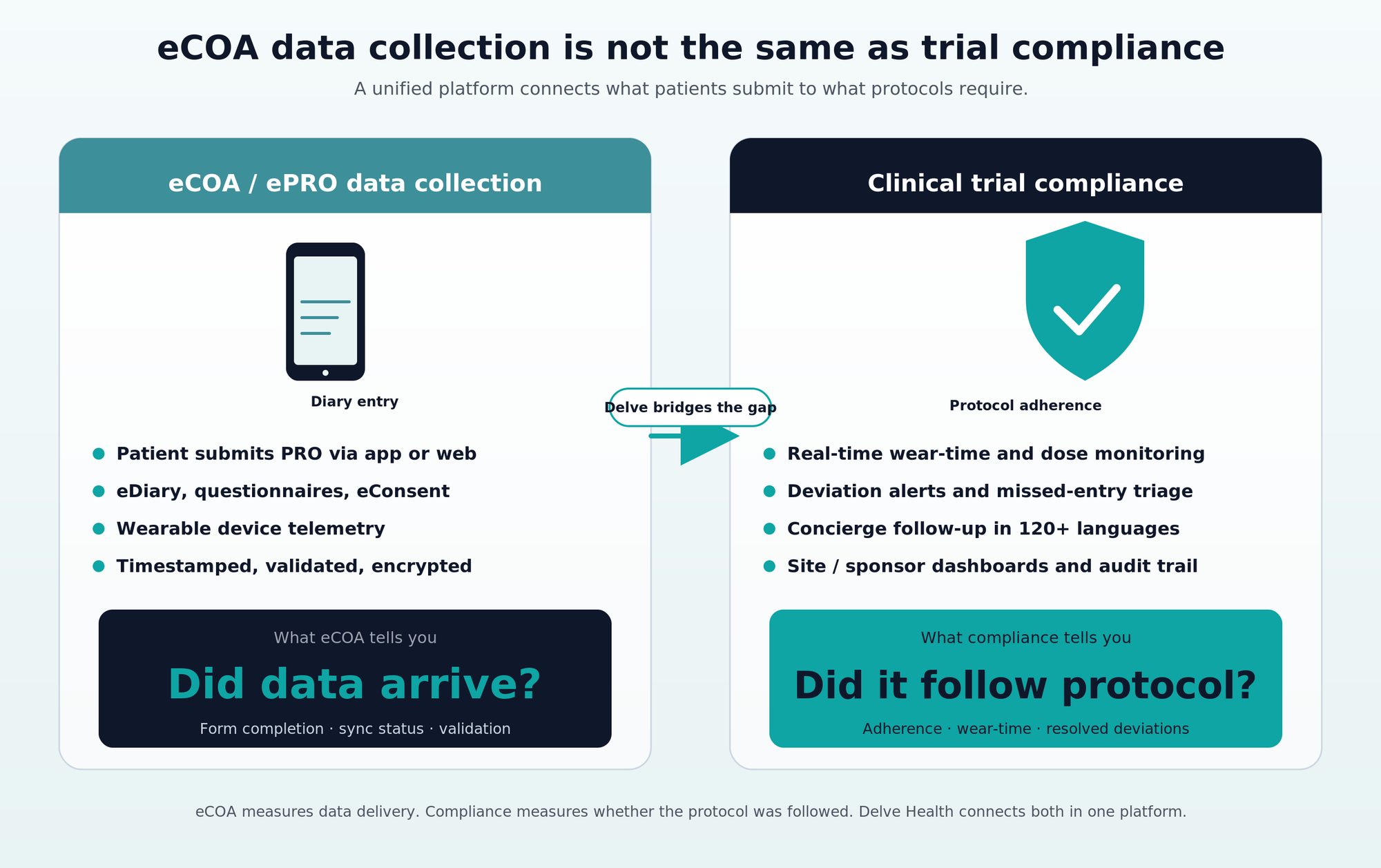
Vendor fragmentation is one of the most common operational risks in clinical trial execution. When eCOA, wearable data, patient support, and site enablement are managed by separate vendors, coordination gaps appear at every boundary.
- Missed assessments visible in the eCOA platform but not acted on by the support team
- Wearable data missing without a connection to the concierge layer that could resolve the sync issue
- Sites expected to bridge gaps between eCOA and wearable systems they were not trained to manage
- Analytics showing a problem that no single vendor owns end-to-end
Delve Health brings these capabilities together so sponsors have one operating model, one escalation path, and one accountability structure for compliance, support, and data quality.
Why Teams Choose Delve for eCOA
Delve is not only an eCOA platform. It is the execution layer that most eCOA vendors expect the sponsor or CRO to build themselves.
eCOA With Built-In Support
Platform and human execution model unified so completion rates are actively managed, not just monitored.
Concierge-as-a-Service™
120+ language support, proactive outreach, and participant recovery built directly into the eCOA workflow.
Native Wearable Integration
Wearable data unified with eCOA in one platform, not managed through a separate siloed vendor relationship.
Site Burden Reduction
Study workflows that reduce coordinator overhead rather than transferring digital complexity onto already burdened site teams.
Frequently Asked Questions
What should I look for when comparing eCOA vendors?
Beyond regulatory validation and interface quality, evaluate patient support model, completion rate track record, wearable integration depth, site burden impact, language coverage, and whether the vendor owns escalation and recovery or leaves it to your team.
What completion rates should a good eCOA platform achieve?
Well-supported eCOA programs with active compliance follow-up typically achieve 90-98% completion rates. Platforms without patient support infrastructure often see 70-85%, with further degradation in long-duration studies.
Does Delve Health offer eCOA as a standalone service?
Yes. Delve's eCOA platform can be deployed standalone or combined with Concierge-as-a-Service, wearable integration, analytics, and site enablement depending on study needs.
How does wearable integration affect eCOA vendor selection?
If your study uses wearable devices, an eCOA vendor that integrates natively with wearable data eliminates a significant coordination gap. Separate eCOA and wearable vendors create fragmented compliance visibility and split accountability for data quality.
What is the difference between eCOA and ePRO?
ePRO, or electronic patient-reported outcome, is a subset of eCOA, or electronic clinical outcome assessment. eCOA includes ePRO but also covers clinician-reported and observer-reported assessments. Delve Health supports all eCOA modalities.
Comparing Delve Against a Specific Vendor?
Head-to-head comparison pages help sponsors evaluating two specific platforms side by side:
Medable vs Delve → Castor vs Delve → Clario vs Delve → Signant vs Delve → YPrime vs Delve → See all →
The Best eCOA Vendor Is the One That Owns Completion
If you are evaluating eCOA platforms, ask each vendor one question: what happens when a participant stops responding? The answer tells you more than any demo.
Compare Delve to Your Current eCOA Vendor