
Deployment
Rapid
Stand up PMCF and RWE studies in weeks, not months
Site touch
Light
Designed for the limited site model of post-market work
Continuity
Long-duration
Wearable + ePRO retention over multi-year follow-up
Post-Market Workflow
Enroll → Monitor → Recover → Report
In clinical research, post-market studies cover the work that happens after regulatory approval — post-market clinical follow-up (PMCF) under MDR, device vigilance, real-world evidence (RWE) programs, and long-term safety / effectiveness follow-up. They share a hard truth: pivotal-trial infrastructure does not survive the transition to post-market work.
Post-market work needs an execution model built for those constraints — not a downsized version of a pivotal-trial stack.
Related pages: Post-Market Studies · Post-Market Compliance

Most post-market programs don't fail at activation. They fail somewhere in months 6–36, when the operational model that was 'good enough' at launch can no longer protect data continuity.
A trial stack built for monthly site visits is too heavy and too expensive to run for years on light-touch follow-up.
Without proactive concierge contact, multi-year cohorts erode silently — and erosion is invisible until interim analysis.
Long-duration wearable studies see compounding sync, charging, and engagement failures that snowball into endpoint damage.
Without real-time compliance monitoring, adverse-event signals surface late — sometimes after they should have triggered action.
Sites accept post-market work assuming it will be light; without operational support, it slowly becomes another protocol-burden item.
PMCF reports and RWE summaries built on patchy data don't satisfy reviewers — and don't help the brand defend its claims.
Post-market evidence isn't just about collecting data — it's about keeping the cohort intact long enough for the data to mean something.
Delve treats post-market as its own discipline — not a leftover protocol from the pivotal trial.
Post-market programs that survive multi-year follow-up are built around longitudinal continuity, not around the launch milestone.
Strong post-market operations look quiet to the patient and steady to the sponsor — that's the whole point.
See related pages: Concierge · MedTech Solutions · Wearables
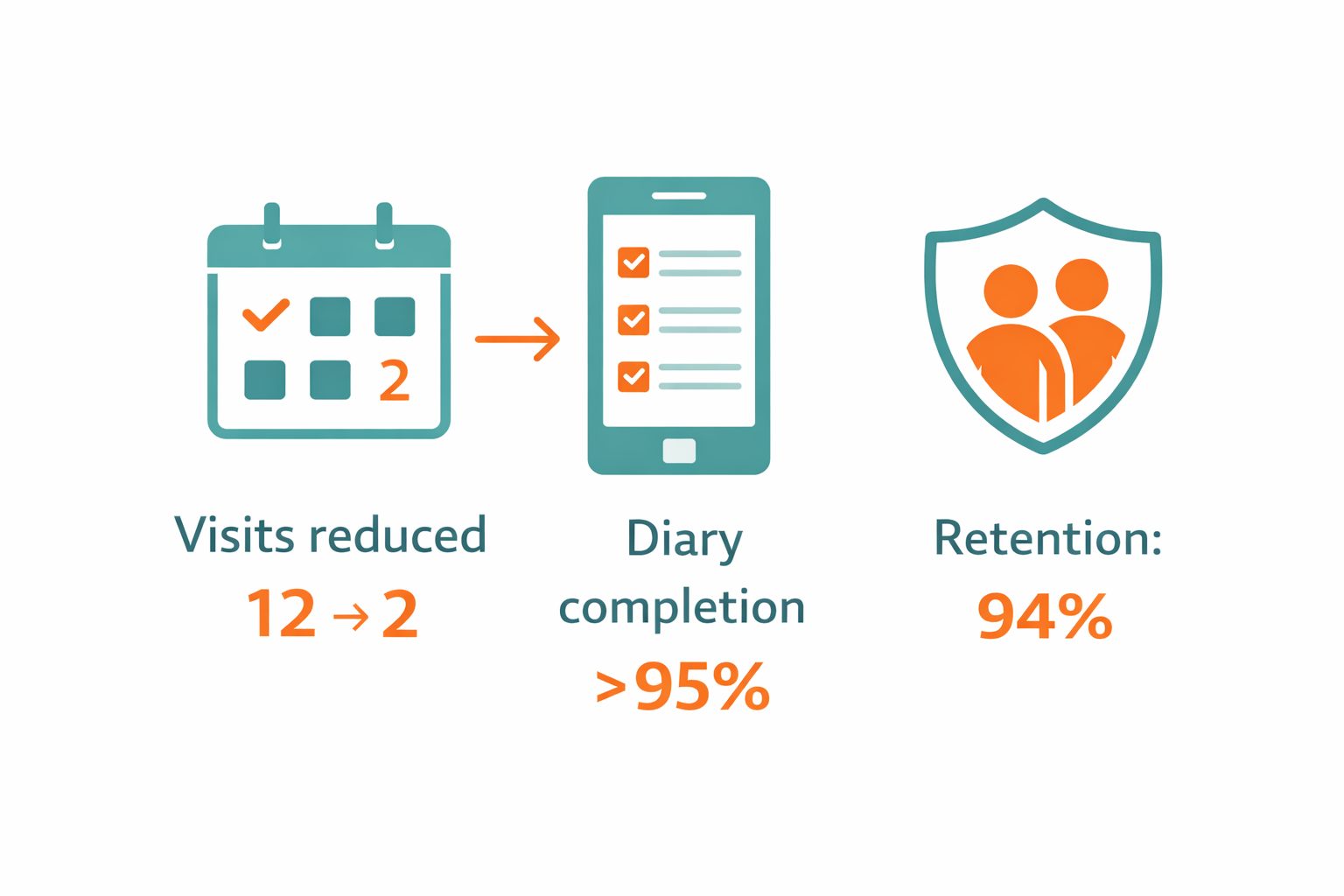
Post-market work pays off when its outputs are organized for the questions reviewers, regulators, and HEOR teams will actually ask.
PMCF reports built on traceable, version-controlled data — not retrofitted from interim spreadsheets.
Signal detection workflows aligned with the cadence and visibility your safety team needs.
Adherence metrics that reflect real-world device and ePRO use over multi-year follow-up.
Endpoint trends across 12, 24, 36+ months — with the provenance to defend them.
Outputs structured for downstream HEOR, real-world value, and reimbursement analyses.
Documentation, lineage, and change history packaged for regulatory follow-up filings.
Post-market outputs are evidence assets. We build them like assets, not afterthoughts.
Yes. We support PMCF design and execution — wearable + ePRO data capture, concierge retention, real-time compliance, and PMCF report-ready outputs. Your regulatory team owns the submission; we deliver the evidence package.
Multilingual concierge follow-up runs throughout the study — not just at launch. Wearable wear-time and ePRO completion are monitored in real time, with proactive outreach when adherence drifts.
Often, yes — that's a strong reason to use Delve in both phases. Endpoints flow through the same harmonization, QC, validation, and Endpoint API layers, so post-market evidence stays comparable to pivotal-trial results.
Delve combines wearables, eCOA, concierge support, and real-time compliance into one execution model designed to protect post-market cohorts and produce defensible evidence — for PMCF, vigilance, and RWE.
Book a Post-Market Discussion