
First 72 hours
↓
Onboarding drop-off
Device sync
⚠
Fails quietly
Who owns it?
?
Between visits
DCT Execution Model
Onboard → Monitor → Outreach → Escalate
About this article. The claims below are drawn from peer-reviewed studies retrieved from PubMed. Each is marked with a numbered citation linking to the full reference and DOI at the end of the page. Figures describe the broader clinical-trial evidence base and are not statements about Delve Health outcomes.
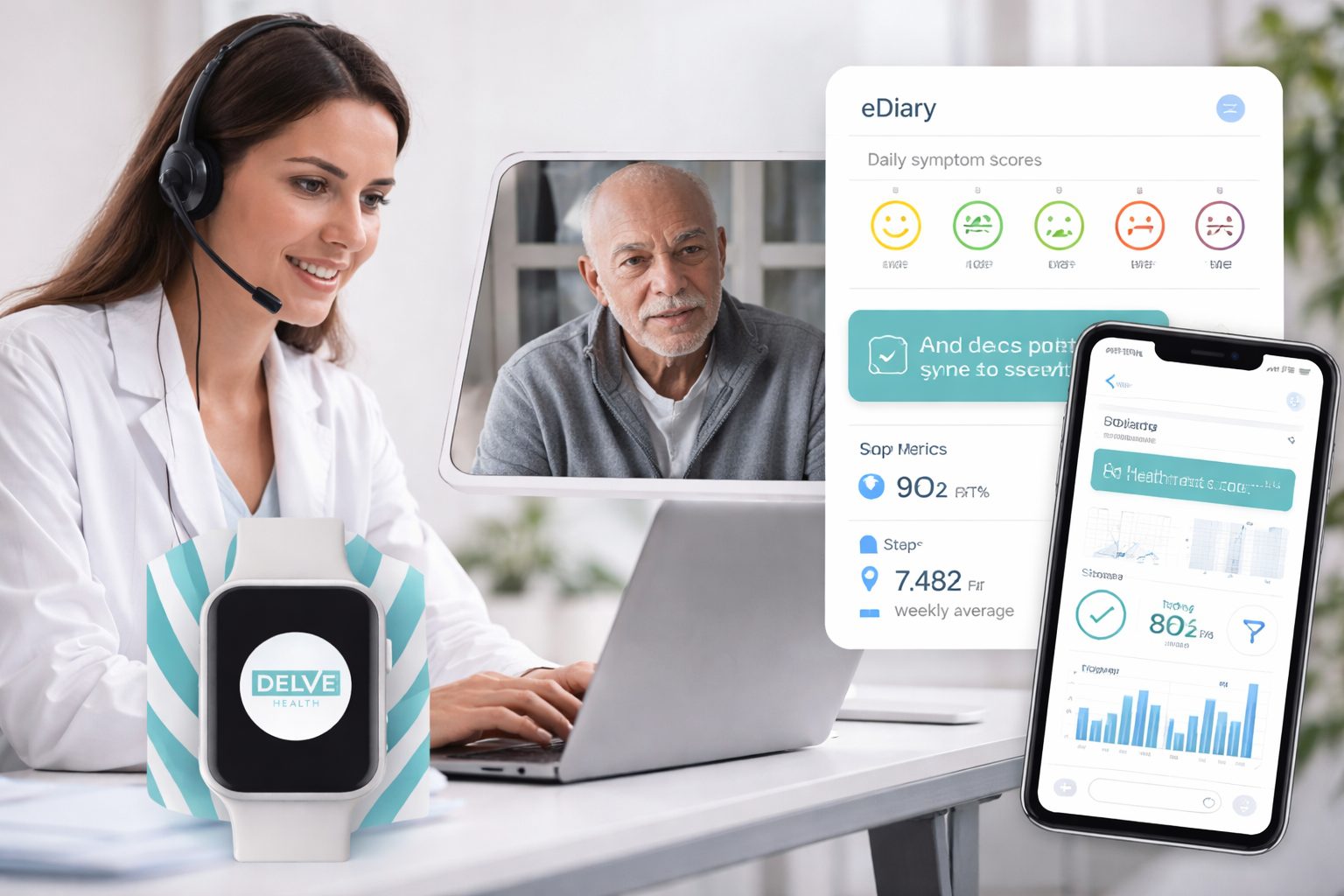
A decentralized clinical trial (DCT) reduces or removes the need for participants to physically visit a research site, relying on tools such as eConsent, apps, wearables, electronic patient-reported outcomes (ePRO), and telemedicine, and moving activities into the participant’s home or local settings.3 Trial design sits on a spectrum from fully decentralized to hybrid to traditional on-site.2
Decentralized clinical trial execution is the operational layer that makes those tools work: patient onboarding, device support, between-visit outreach, data monitoring, and site backup. Reviews of DCTs stress that the quality of evidence and the physician–patient relationship must not be undermined as activities move off-site.2

These failure modes are not anecdotes. Each is supported by published clinical-trial research.
Regulators flag reduced investigator oversight and limited face-to-face contact as core DCT risks;1 staff interviews link weaker patient contact to worse engagement and retention.4
Even in feasible wearable studies, complete data were obtained in only 72–81% of participants, depending on device—gaps that rarely trigger an alarm.6
Research staff report the demands of their role increase under DCTs, making consistent remote follow-up harder to deliver.4
Across 1,342 patients in three respiratory trials, daily ePRO adherence declined after randomization, and pre-enrollment adherence predicted later adherence.5
Stakeholders name compliance and adherence as key barriers; clear instructions and direct patient assistance are named facilitators.8
A meta-analysis of 70 app-based randomized trials found pooled attrition of 24.7%, rising to 38.7% in larger studies.9
DCTs raise data-integrity concerns at the point of capture, during transmission, and in analysis—each a place signal can be lost.3
The participants DCTs aim to help—rare disease, pediatric, elderly, and caregiver-dependent—carry the most burden when execution slips.11
Across 172 randomized trials, retention was higher when contact was person-to-person rather than at-a-distance.10
Strong decentralized and hybrid execution combines four layers that most “platforms” sell as one but rarely deliver together. Each maps to a finding in the literature.
Adherence is achievable when device and support fit: in one screening trial, a wearable ECG patch reached a median wear time of 27.4 of 28 days and was well tolerated.7 This is what an execution team delivers, supported by software.
Key figures from peer-reviewed clinical-trial research, retrieved from PubMed. Full citations are listed under References.
of surveyed sponsors, device makers, and CROs used decentralized techniques in the early pandemic.3
pooled attrition across 70 app-based randomized trials (38.7% in larger studies).9
of participants yielded complete wearable data in a feasibility study—device-dependent gaps remain.6
showed ePRO adherence declining over time after randomization across three respiratory trials.5
median wearable ECG patch wear time in a screening RCT—high adherence is achievable with the right setup.7
linked higher retention to person-to-person rather than at-a-distance contact.10
participant retention across 172 behavioural randomized trials (IQR 68.5–89.5%)—it varies widely by design and contact.10
EU regulators interviewed on DCTs cited gains in access and retention, alongside reduced oversight and limited face-to-face contact.1
A decentralized clinical trial reduces or removes site visits, using eConsent, apps, wearables, ePRO, and telemedicine, with activities moved into the participant’s home or local settings.3
Trial design sits on a spectrum from fully decentralized to hybrid to traditional on-site; a hybrid trial blends remote and in-person visits, and most DCTs in practice are hybrid.2
Evidence points to person-to-person contact for retention,10 clear instructions and direct assistance to reduce friction,8 and proactive monitoring because adherence declines over time.5
They can, when execution is sound. Regulators see DCTs as a way to improve access and retention but emphasize oversight, safety, and—often—hybrid designs;1 reviews stress protecting data integrity and the physician–patient relationship.2
Participant-centric, decentralized approaches are especially valuable where burden is high—rare disease, pediatric, and elderly populations, and participants who depend on caregiver assistance or live far from sites.11
Delve Health combines the Clinical StudyPal platform, wearable and eCOA workflows, device logistics, and concierge patient support, operating the between-visit window so sponsors are not relying on dashboards alone.

Evidence summarized in this article was retrieved from PubMed (U.S. National Library of Medicine). Each citation links to the original peer-reviewed article via its DOI.