
Where wearable studies actually fail
Integrating a device is the easy 20%.
THREAD's flexibility and integration breadth are real strengths for assembling a decentralized study. But when device data is unified through middleware and partners, accountability for signal quality fragments: raw data flows, yet no single party owns whether it is complete, validated, and usable as an endpoint. Delve owns that layer — validated algorithms, signal QC, and wear-time recovery — under one roof.
Bottom line: If you want a flexible DCT platform and you have the internal capacity to manage device-data quality across partners, THREAD is a capable choice. If you want one party accountable for validated endpoints and signal quality end-to-end, Delve is the better-fitting platform.
Where THREAD Research and Delve genuinely overlap
At the capability level, both can support a modern wearable-enabled trial. Both typically offer:
- Configurable decentralized and hybrid trial support
- eCOA / ePRO, eConsent, and televisit capabilities
- Wearable and sensor device integrations
- Real-time study oversight dashboards
The differences show up once you ask what happens when a participant stops wearing the device, when a sensor produces unusable data, or when an endpoint depends on validated algorithms across more than one device.
Side-by-side comparison
THREAD Research vs Delve Health: capability comparison
The table reflects publicly documented positioning and standard delivery models for each platform. Specific configurations vary by contract.
| Capability | THREAD Research | Delve Health |
|---|---|---|
| Signal quality & endpoint integrity | ||
| Validated digital-endpoint algorithms | Partner / vendor-supplied | 70+ algorithms owned, across 25+ devices |
| Device data unification | Often via middleware / partners | One harmonized data layer |
| Signal quality control / completeness | Depends on source / middleware | Owned QC layer — drift & sync detection |
| Wear-time recovery (human) | Platform tooling; services optional | Concierge in 120+ languages, proactive |
| Accountability for endpoint integrity | Shared across partners | Delve owns it end-to-end |
| Human concierge patient support | Via partners / services | 120+ languages built in |
| eCOA / ePRO included | Yes | Fully configurable eCOA |
| Per-study completion accountability | Customer / partner-driven | 92–98% documented per study |
| Compliance posture (HIPAA, GDPR, 21 CFR Part 11, GCP, ISO 27001) | Yes | Yes |
Why wearable-heavy studies pick Delve
Four reasons sponsors choose Delve when wearable endpoint integrity, wear-time, or retention is the deliverable — not the customer's problem to solve.
Completion is the deliverable
Delve publishes documented 92–98% per-study eCOA/ePRO completion ranges and up to 63% retention uplift in long-duration cohorts — platform-owned, not the customer's problem to solve.
Validated algorithms across many devices
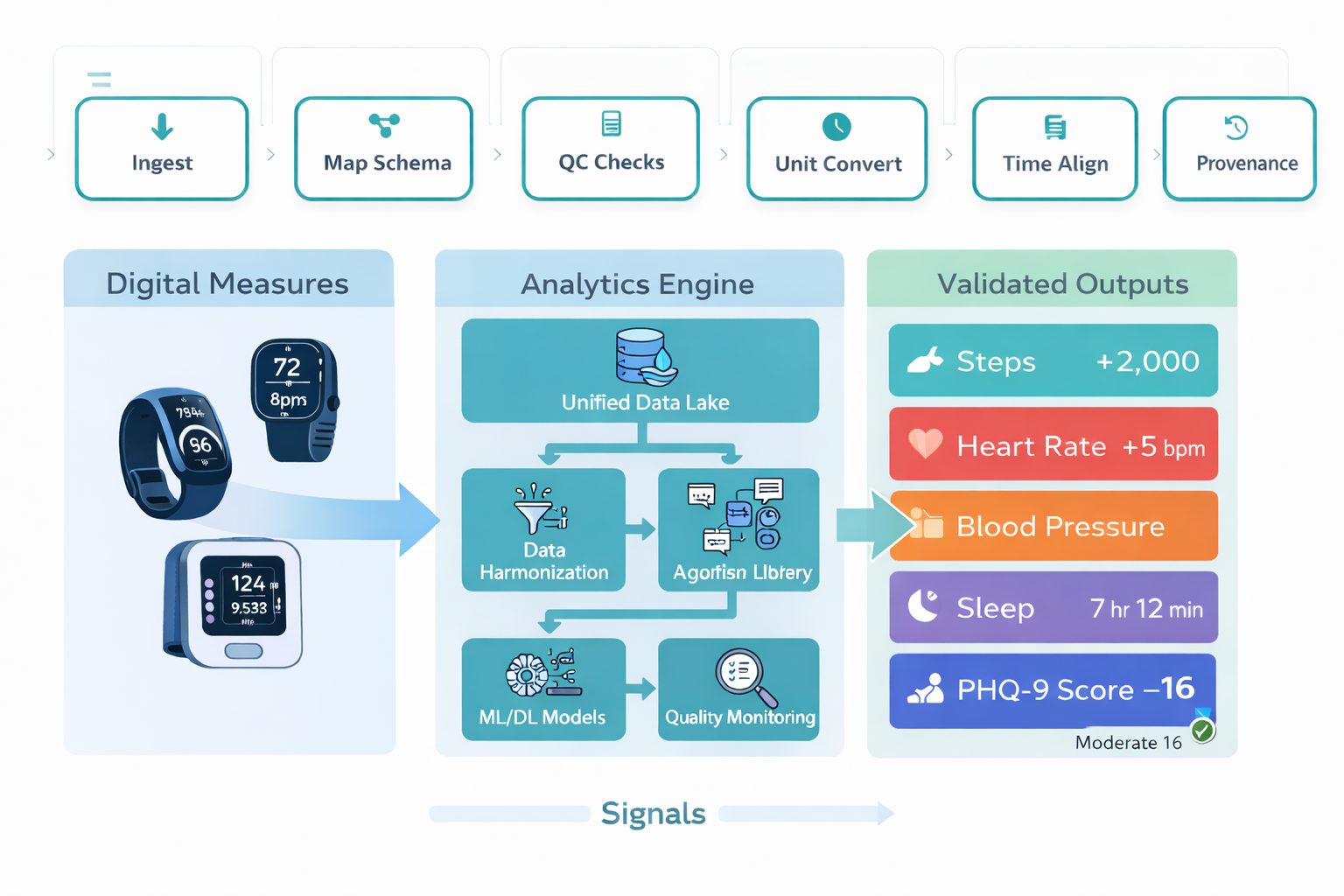
70+ validated digital-endpoint algorithms across 25+ devices on one harmonized data layer that normalizes units, sampling rates, time bases, QC flags, and algorithm versions.
Signal quality, owned end-to-end
Signal quality control validates completeness, flags drift, and catches sync failures before data is lost — not discovered at database lock.
Humans recover wear-time
Concierge-as-a-Service in 120+ languages recovers participants before wear-time decays — proactive outreach, device troubleshooting, escalation.
Which platform fits your study
Choose the platform that fits your operating model
Choose THREAD Research if…
- You want a highly flexible, configurable DCT platform
- You value breadth of device and data-provider integrations
- You have internal capacity to manage device-data quality across partners
- You prefer to assemble services and integrations to your own design
Choose Delve Health if…
- You want one party accountable for validated endpoints and signal quality
- You want device data on one harmonized layer, not stitched via middleware
- You need signal QC and human wear-time recovery built in
- Your study is wearable-heavy, long-duration, or compliance-critical
- You want documented per-study completion (92–98%)
Frequently asked questions
Questions sponsors ask when comparing THREAD Research and Delve Health
Is Delve Health a THREAD Research alternative?
Yes. THREAD offers a flexible DCT platform with broad device integrations, often unified through middleware and partners. Delve owns validated algorithms, signal quality control, and wear-time recovery on one harmonized data layer. Sponsors who want a single party accountable for endpoint integrity typically prefer Delve.
What is the risk of unifying device data through middleware?
When device data flows through middleware and partners, accountability for signal quality fragments. Data moves, but no single party owns whether it is complete, validated, and usable as an endpoint. Delve owns that layer end-to-end, which reduces the coordination gaps where data is lost.
Does THREAD provide validated algorithms or vendor-supplied metrics?
THREAD generally relies on partner or vendor-supplied metrics for device data. Delve runs 70+ validated digital-endpoint algorithms it owns across 25+ devices, so the measure and its validation evidence come from one source.
How do the patient-support models compare?
THREAD provides platform tooling, with services available via partners. Delve includes Concierge-as-a-Service in 120+ languages built into the platform that proactively recovers wear-time before data goes missing.
Which is better for wearable endpoint integrity?
Both can run wearable studies. Delve's advantage is owning the validated algorithms, signal QC, and wear-time recovery in one place, so endpoint integrity is engineered rather than assembled across partners.
Evaluating Delve against THREAD Research?
Ask each vendor one question: what happens to your endpoint when a participant stops wearing the device? The answer tells you more than any device list.
Book a Platform Walkthrough