
Where wearable studies actually fail
A gold-standard device is not a whole study.
ActiGraph's pedigree is real: granular, validated actigraphy trusted in academic and post-market work. But it is a device and analytics for one measure class. Multi-device protocols, eCOA, cellular and non-app capture, logistics, and wear-time recovery all sit outside it. Delve provides that execution layer and can run activity and sleep endpoints across devices, ActiGraph included.
Bottom line: If your study is single-measure actigraphy and you want the research-grade standard, ActiGraph is an excellent device choice. If you are running a broader, multi-device, execution-critical wearable program, Delve is the platform that wraps around it.
Where ActiGraph and Delve genuinely overlap
At the capability level, both can support a modern wearable-enabled trial. Both typically offer:
- Research-grade activity and sleep measurement
- Validated actigraphy algorithms
- Objective, sensor-derived endpoints
- Credibility in academic and post-market studies
The differences show up once you ask what happens when a participant stops wearing the device, when a sensor produces unusable data, or when an endpoint depends on validated algorithms across more than one device.
Side-by-side comparison
ActiGraph vs Delve Health: capability comparison
The table reflects publicly documented positioning and standard delivery models for each platform. Specific configurations vary by contract.
| Capability | ActiGraph | Delve Health |
|---|---|---|
| Signal quality & endpoint integrity | ||
| Validated digital-endpoint algorithms | Actigraphy (own devices) | 70+ algorithms across modalities |
| Modalities beyond activity & sleep | Actigraphy focus | ECG, glucose, respiratory, cardiovascular and more |
| Device breadth | ActiGraph devices | 25+ devices, incl. ActiGraph |
| Signal quality control / completeness | Device-level | Owned QC layer |
| Wear-time recovery (human) | No | Concierge in 120+ languages |
| eCOA / ePRO included | No | Fully configurable eCOA |
| Device logistics & provisioning | Own hardware | End-to-end across devices |
| Per-study completion accountability | Customer-driven | 92–98% documented per study |
| Compliance posture (HIPAA, GDPR, 21 CFR Part 11, GCP, ISO 27001) | Yes | Yes |
Why wearable-heavy studies pick Delve
Four reasons sponsors choose Delve when wearable endpoint integrity, wear-time, or retention is the deliverable — not the customer's problem to solve.
Completion is the deliverable
Delve publishes documented 92–98% per-study eCOA/ePRO completion ranges and up to 63% retention uplift in long-duration cohorts — platform-owned, not the customer's problem to solve.
Validated algorithms across many devices
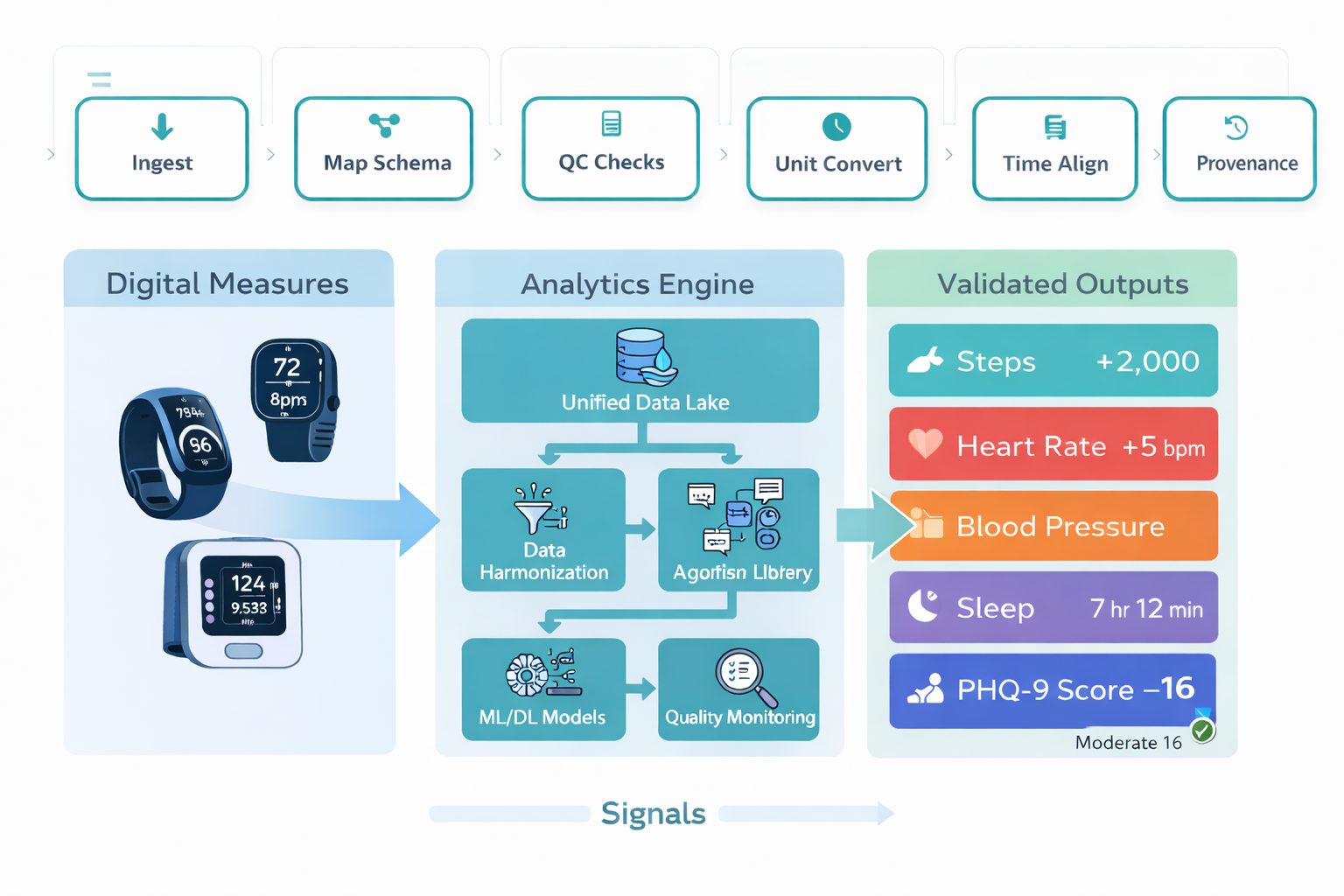
70+ validated digital-endpoint algorithms across 25+ devices on one harmonized data layer that normalizes units, sampling rates, time bases, QC flags, and algorithm versions.
Signal quality, owned end-to-end
Signal quality control validates completeness, flags drift, and catches sync failures before data is lost — not discovered at database lock.
Humans recover wear-time
Concierge-as-a-Service in 120+ languages recovers participants before wear-time decays — proactive outreach, device troubleshooting, escalation.
Which platform fits your study
Choose the platform that fits your operating model
Choose ActiGraph if…
- Your study is single-measure actigraphy (activity, sleep, movement)
- You want the established research-grade device and its validation history
- You are running academic or post-market activity and sleep work
- You have wear-time, eCOA, and logistics handled in-house
Choose Delve Health if…
- Your study is multi-device or multi-modality, beyond activity and sleep
- You need signal QC and human wear-time recovery
- You want eCOA, logistics, and analytics in one platform
- You want to run many devices, ActiGraph included
- You want documented per-study completion (92–98%)
Frequently asked questions
Questions sponsors ask when comparing ActiGraph and Delve Health
Is Delve Health an ActiGraph alternative?
For single-measure actigraphy, ActiGraph is a research-grade standard. Delve is a broader execution platform: validated algorithms across many devices and modalities, plus signal QC, wear-time recovery, eCOA, and logistics. Delve can also run ActiGraph devices within a larger study.
Does ActiGraph cover modalities beyond activity and sleep?
ActiGraph specializes in actigraphy: activity, sleep, and movement. Delve runs validated algorithms across additional modalities including ECG, glucose, respiratory, and cardiovascular signals, on one harmonized data layer.
Does ActiGraph include wear-time recovery or eCOA?
ActiGraph is a device-and-analytics offering and does not provide a concierge wear-time model or built-in eCOA. Delve includes both, with concierge in 120+ languages and fully configurable eCOA alongside wearables.
Can Delve run ActiGraph devices?
Yes. Delve is device-agnostic and integrates many device classes, ActiGraph included. The deciding question is whether you want a single research-grade device or a platform that runs many devices with QC, wear-time recovery, and eCOA around them.
Which is better for activity and sleep endpoints?
Both handle activity and sleep well. ActiGraph offers a long-validated single device; Delve offers validated activity and sleep algorithms across multiple devices plus the execution layer that protects wear-time and signal quality across the study.
Evaluating Delve against ActiGraph?
Ask each vendor one question: what happens to your endpoint when a participant stops wearing the device? The answer tells you more than any device list.
Book a Platform Walkthrough